Continuing my short series of write-ups from the recent "Real Wines" tasting, hosted by Les Caves de Pyrène in London, here are some notes on a few other French growers. Remember, the prices shown are the advertised trade prices (so add on a few quid - plus VAT - for possible retail prices);
Domaine Albert Mann, Alsace
Riesling Tradition 2008 (£10.10) - A nose of mandarin oranges, flowers and stony minerality. There's a lot of residual sugar and I'm not really sure about the lack of real acidity. It seems blowsy, but then again it is young, so perhaps it will all knit together eventually.
Pinot Gris Tradition 2008 (£12.05) - Rich, sweet, oaky. Nice weight and excellent balancing acidity. This is really good - and long. I liked it a lot.
Pinot Gris Cuvée Albert 2008 (£13.75) - Again, quite oaky. Lemon and marmalade aromas and flavours, but it is a touch rich and cloying for my palate. I much preferred the Tradition.
Gewurztraminer Tradition 2008 (£12.90) - Simple turkish delight aromas and flavours. A bit sickly for my taste. Then again, I'm not a huge fan of the variety - I'm still searching for the holy grail of a Gewurz with zingy acidity to counter all those flowery, sugary notes.
Domaine Pierre Frick, Pfaffenheim
I tried a couple of these wines, purely because somebody told me how oxidised they were. I say "tried", since I did not actually taste them - they all appeared to be rather dark in colour, and one sniff was enough to tell me I shouldn't taste them. This grower is obviously one of those making so-called "natural wines" - some of them even proudly describe themselves on the labels as "sans soufre". Which says everything about the perils of using zero sulphur. To be fair (I really am searching hard for something good to say) these particular bottles may well have been open since the day before, but I've rarely found any white wine that has gone truly "off" overnight. There is every possibility that these wines were very good on the day they were actually bottled. It's just a shame they (or at least the ones I sniffed) had such a short life.
Domaine Jean Foillard, Morgon
Morgon Classique 2008 (£11.45) - Light, fruity and elegant, though not serious.
Morgon Cote de Py 2008 (£15.70) - This is altogether bigger, more extracted, with grapeskins, beef and leather on the nose. The palate is more elegant than the nose, medium-to-full bodied, with lots of fruit, but also quite a lot of tannin. Needs time, but a very good wine for the medium term.
Morgon Cuvée 3.14 2007 (no price given - this was an extra addition to the tasting, but not listed) - Presumably, this is a play on numbers/words - 3.14 being Pye (as opposed to Py). It is rich, extracted and powerful, but nevertheless very elegant. A keeper - give it a few years and it could be quite special. I like these wines - serious Beaujolais.
Maison Philippe Pacalet, Gevrey
Gevrey-Chambertin 2008 (£36.95) - Is it me, or do I again detect "natural"? It smells strongly of candied fruit and sugar - or is it too heavily chaptalised?. I found it unforgiving and charmless.
Gevrey-Chambertin ier Cru Bel Air 2008 (£54.60) - More perfumed, but not in a recognisable Pinot way. Not for me.
Puligny-Montrachet 2008 (£45.55) - I didn't write anything for this wine. I guess I was similarly unimpressed.
Chambolle-Musigny 1er Cru 2008 (£55.15) - This is more like it. Spicy, rather than fruity. Good acidity and grip, although I found it flowery, with not a lot in the way of primary fruit. Interesting.....
Gevry-Chambertin 1er Cru Lavaux St Jacques 2008 (£60.50) - This smells jammy and tastes jammy, with a streak of bitterness. Or perhaps I'm just having an off day. I have heard good (nay, great) things about this grower's wines, from a couple of friends whose palates I respect. Then again, they weren't tasting the 2008's. Was 2008 that bad a year, or was I having a bad day? Or do I just not like this grower's house style? As the saying goes, it's Burgundy, Jim, but not as we (or at least I) know it.
Tomorrow, I'll finish off my report with notes on some really brilliant (and a few awful) Italian wines.
Sunday, 25 April 2010


Saturday, 24 April 2010
The good, the bad and the ugly - "Real Wines" at Les Caves de Pyrène (part 1)
"Real Wines" was the title of this trade event, held on 19 and 20 April in London, designed to showcase several hundred wines from what seems like merely a fraction of the growers now listed by Les Caves de Pyrène. This particular importer specialises in biodynamic and organic growers, with a good many falling in the "natural" category (although I - and presumably the growers - use that term fairly loosely). Many of the wines were wacky and weird. Some were really good, even excellent, whilst some were merely OK - and others were just plain bad. I'll try not to spout on about the bad ones too much, since I have more than a little admiration for the philosophy of the buyers at Les Caves de Pyrène - namely, to seek out new and interesting growers who are pushing the boundaries of winemaking (or "pushing the envelope", as some like to put it) and trying to make their wines in a non-interventionist (or "natural") way.
It was a long day, and there were an awful lot of wines on offer, so I didn't get the chance to taste through all of them. I guess I must have tasted around 100 altogether. Mostly, they were the wines I had heard good things about or wines I had already tasted and enjoyed on previous occasions, plus a few stabs in the dark. I'll post the notes not in the order I tasted, but in the order they appeared in the tasting booklet. There are too many to fit into a single post, so I'll spread them out over 3 entries. We'll begin with southern France. Prices shown are the advertised trade prices (so add on a few quid - plus VAT - for possible retail prices);
Domaine du Pech, Buzet
Vin de Table Le Pech Abusé 2004 (£10.35) - Cherries and meat stock nose. Rich black fruit palate - bramble and blackcurrant. Spicy, with decent acidity. Very tannic, but with loads of fruit. Needs food.
Domaine Elian de Ros, Cotes du Marmandais
Clos Baquey 2006 (£20.15) - Deep colour. Lifted aromas of summer fruits and a touch of cedar. Rich, dark fruits on the palate ,with stout tannins, but great balancing acidity. Needs food, but a really good wine. At that price, though, it should be.
Clos Lapeyre, Jurançon
Jurançon Sec 2008 (£8.55) - Displays bitterness, rather than the trademark Jurançon acidity. Not for me.
Vitatge Vielh de Lapeyre 2006 (£11.40) - Nicer, but still lacks freshness. Rich, but ultimately harsh.
Jurançon Vent Balaguer 2005 (£41.85 for 50cl) - Barley sugar and botrytis(?) Uber-rich, with lovely acidity and fabulous sweetness. Orange marmalade, lemon, toffee, tea, ginger and spice. Massive structure and very long and spicy. A wonderful wine. Then again, it needs be, since it is bound to retail at well over 50 quid for the 50cl bottle.
Clos du Gravillas, St Jean de Minervois
Minervois Blanc l'Inattendu 2008 (£14.95) - Toasty, coconutty oak and stone fruits. Rich and long, with notes of liquorice and sweet candied fruits. Very good stuff.
Soux Les Cailloux des Grillons 2008 (£8.75) - Rich and very ripe, but nicely balanced and winey. Pastille fruit, herbs and spices. It's lovely already, but give it 3 more years.
Domaine Matassa, Cotes du Roussillon
Vin de Pays Cotes Catalanes Blanc 2007 (£24.20) - Smells of sulphur, like a struck match. It is trying to smell fruity, but failing. Rich, even fiery, and a bit volatile. Not my cup of tea.
Vin de Pays Cotes Catalanes Blanc 2008 ("POA") - Oak and more oak. But not much in the way of fruit. Bitter lemon pith flavour. Oh dear.
Vin de Pays Cotes Catalanes Rouge Romanissa 2006 (£15.70) - A hint of soft red fruit, but there is also a touch of bitterness. Tannic and extracted, although I feel it may be interesting in a few years.
Vin de Pays Cotes Catalanes Rouge Romanissa 2007 ("POA") - Sulphur. Soft, pastilley fruit again, but still a bit astringent. The jury is out on this one, too.
Domaine d'Auphilac, Montpeyroux
Coteaux de Languedoc Montpeyroux 2006 (£10.95) - A curious hint of gloss paint on the nose. The palate is lovely, though, with soft red and black fruits, spice and garrigue herbs. Plenty of tannin, but nicely balanced. One to keep.
Les Servieres Vin de Pays de l'Hérault 2009 (£8.35) - Pastille fruits and lifted aromas. Super-ripe, super-rich and super-modern. Seems like there's some added acidity here, but it is not enough to redeem what is essentially a sweet and over-extracted wine.
Domaine Hauvette, Les Baux de Provence
Mas Hauvette, Coteaux des Baux (£19.40) - Raisiny and baked, almost like a 2003. Perhaps this bottle was on its second day but, nevertheless, this seems like a very tired wine. Why are they still selling the 2004 vintage?

Who is this man that keeps appearing in my photos?!
The tasting room, with Bernard looking eager to get on with some serious tasting
Tomorrow, I'll post further notes on some wines from Alsace and Burgundy. Following that, I'll do Italy. Meanwhile, it's Saturday morning, so I'm off to play golf!
Tuesday, 20 April 2010
A delicious sticky from Portugal
Jancis Robinson’s Oxford Companion To Wine states that “colheita” is a Portuguese word meaning “crop” or “harvest” and, by extension, “vintage”. This is made from 100% Moscatel de Setúbal (more commonly known as Muscat of Alexandria). The fermentation is stopped at a certain level of sweetness, by the addition of grape spirit. At just 17.5% abv, I assume that only a relatively small amount of spirit is used – which is just how I like my fortified wines. The grape skins are then left to macerate in the wine for up to 6 months, which adds a grapey freshness, not to mention intense aromas and flavours. Up to 5 years’ ageing in barrel adds richness and makes for an ever-so-slightly oxidative style of wine, with a definite marmalade tang.
 Bacalhôa Moscatel de Setúbal Colheita 2003
Aged for 3 years in small oak barrels, this wine is simply beautiful on the eye – a limpid amber/gold colour with a definite pink rose tinge. The nose offers an absolute riot of aromas, including (but by no means limited to) orange marmalade, lime zest, roses, tea, toffee apple, apricot and a sprinkling of herbs. The palate is rich and honeyed and coats the mouth with complex, multi-layered flavours of marmalade, ginger, toffee, citrus and all manner of preserved white fruits. Some less skilfully-made fortified Muscats can be a little cloying, with the acidity masked by excess grape spirit, resulting in alcoholic burn. But this one is so beautifully balanced that everything comes together in a wine that I’m finding hard to fault, with plenty of acidity to match the luscious sweetness. The result is a very rich but remarkably refreshing wine, which is devilishly drinkable. There is a distinct tangy, almost sweet and sour quality that almost puts me in mind of a 5 or even 6 Puttonyos Tokaji. In fact, if you were to age this for another 5 to 10 years (if you can resist, that is) you might even mistake it for one – it is that good. Whilst 2003 was a very difficult vintage for dry wines and indeed for many naturally sweet or late-harvest wines, it clearly posed no such problems for makers of fortified wines. And this is a glorious example of its kind – not to mention an amazing bargain. This was a sample bottle given to me by a local wine merchant friend and I may well add it to my list, at around £11.95. Watch this space….
Sunday, 18 April 2010
A lovely evening of wines from Domaines Ott
Here’s the report I promised you on the tasting held earlier this week at the Nottingham Wine Circle. Our friend Mike Lane was actually on holiday recently near Narbonne, which (if you know your geography) is a long way from Bandol. Nevertheless, he and a friend made the 450+ mile round trip in a day, purely to visit Domaines Ott and taste through the range of wines from the three different estates which bear the Ott name. As far as I am concerned, it was well worth it. We tasted 14 different wines, including no less than 6 rosés……

Some of the wines in the line-up (sorry for the poor quality - I only had my mobile phone to hand)
White
Les Domaniers 2008 Côtes de Provence
10 % Rolle, 90% Semillon. Citrus fruits, peaches and minerals on the nose. Apples and spring flowers, too. Quite rich, but zingy with it. If I had a criticism, it is a little hollow in the middle, but a nice wine to start with, nevertheless. €9.95.
Clos Mireille 2007 Côtes de Provence
30% Rolle, 70% Semillon.Very perfumed on the nose, with hints of talc and flowers. Somebody mentioned lavender, and we all agreed - this is Provence, after all, so for the scents of the countryside to come through in the wine shouldn't come as a surprise. I even detected hints of olive oil on the nose. The palate was again fairly rich, with citrus fruits and hints of apples and herbs. Delicate and elegant and really rather nice. I didn't note the price, but this retails for about £20 in the UK.
Rosé
Les Domaniers 2008 Côtes de Provence60% Grenache, 40% Cinsault. A nose of vanilla and crème brûlée, with subtle hints of herbs and red fruits. A soft entry on the palate, with lovely sweet red fruits and nice acidity. Lovely rosé. €9.95.
Clos Mireille Cœur de Grain 2008 Côtes de Provence
A blend of Grenache, Cinsault and Syrah. This has more of everything, being richer, more powerful and more flavoursome. Whether that makes it a more enjoyable wine to drink is up for discussion. The previous wine was just so enjoyable to drink now, although maybe in a more immediate and less structured way. This one probably needs another year or two in bottle to show its true promise. €22.05.
Château Romassan Cuvée Marine 2008 Bandol
10% Grenache, 75% Cinsault, 15% Mourvedre, aged in oak for 2 months. Ultra-pale onion skin colour. More muted on the nose than the previous wine, or perhaps just more subtle - but definitely more complex. Indeed, it is almost like a white Burgundy in structure, with flavours of mineral, peach and citrus. Long and complex and lovely. €21.33.
Château Romassan Cœur de Grain 2008 Bandol
A blend of Grenache, Cinsault and Mourvedre, although the percentages aren't specified. Ultra-pale colour again. A nose of herbs and spices (Lincolnshire sausages, curiously enough) and also quite biscuity, almost reminiscent of an aged Champagne. The palate is more in the way of red fruits, like cherries and redcurrants. Also quite spicy and herby. Long and warming and lovely. €22.05.
Château Romassan Cœur de Grain 2006 Bandol
Same blend. Another wine with a nose of vanilla custard. A few of detected a hint of TCA, so it wasn't really possible to make a judgment on this one. It also seemed a touch oxidative. That said, it was hanging on quite well, albeit in an aged sort of way - and I would expect a fine Bandol rosé to age better than this.
Château Romassan Cuvée Marcel Ott 2007 Bandol
Mourvedre and Cinsault, aged 8 months in oak. This again smells (and tastes) almost like a white Burgundy. A touch of very classy, very subtle oak-ageing. This really is a very fine wine, and if I were tasting it (completely) blind, I would be convinced it was a particularly fine white Burg.
Red
Les Domaniers 2007 Côtes de Provence
58% Syrah, 20% Cinsault, 10% Grenache and 12% Mourvedre. Initially quite modern, slightly jammy, almost southern hemisphere. Then you get hints of VA and pepper and tarry oak. The palate is beautifully balanced, fruity ,rich but light on its feet. The more you smell and taste it, the more it seems like a northern Rhone wine. Not a serious wine, but a complete joy to drink. Not sure about the price.
Château Romassan 2005 Bandol
90% Mourvedre and 10% other grapes (not sure which).Soft, almost citrussy fruit. It smells like a Bandol, but is so soft and easy to drink. The colour is only light-to-medium, suggesting a fairly low extraction and (I would guess) complete de-stemming of the grapes. It is subtley oaked, with red and black fruits and notes of cedar. Not typical Bandol, and not built for ageing, but a delight to drink right now. €22.65.
Château Romassan 2004 Bandol
This is fuller and richer and more heavily extracted, with more in the way of oak/cedar..... and perhaps even a touch corked. Seems like there's a good wine in there, but difficult to assess. €22.65.
Château De Selle Côtes de Provence 2003
90% Cabernet Sauvignon and 10% other grapes. Blackcurrants and cedar, citrus fruit and VA. This is amazingly light and balanced for a 2003. Quite tarry (as are many 2003's), with notes of beef gravy and roses, reminiscent of Barolo. It is also quite similar to my Chateau d'Estoublon Jeune Vignes 2003, which suggests that Cabernet Sauvignon was well-suited to the conditions of the 2003 vintage. I liked this very much. €22.
Château Romassan Longue Garde 2001 Bandol
50% Mourvedre, 20% Grenache, 20% Cinsault, 10% Syrah. Lots of volatile acidity, beetroot, red cabbage, even a bit oxidised. Absolutely full of faults (and perhaps an iffy bottle) but it had plenty of secondary/tertiary flavours and I really liked it, as did some other members of the group. Not cheap, though, at €29.
Château De Selle Longue Garde 2000 Côtes de Provence
90% Cabernet Sauvignon and 10% other grapes. A riot of violets and smoked sausages, with bags of fruit aromas and flavours. 90% Cab? For all the world, I’m in the northern Rhone with this one. Lovely, soft fruit flavours and relatively low tannins, but it has real underlying structure, with excellent acidity. A glorious wine, which is perfect to drink now.
We finished off with a more traditional, aged Bandol, kindly provided by David Selby, our ever-generous group Secretary.
Domaine Tempier La Tourtine 1995 Bandol
Again, this is very northern Rhone in style, which is actually what I have come to expect from aged Tempier wines. Salty, meaty, a touch bretty perhaps, but also very floral, with distinct notes of violets and lilies – yet it is mostly Mourvedre. Rich but balanced, even elegant, with superb underlying acidity. It isn’t quite peaking yet, but is not far off. Long, herby, spicy and complex. A real cracker.
One or two at the tasting were critical of the prices of the Ott wines. Indeed, they are far from cheap, but one must remember that these are the wines of choice of the hordes of rich and famous people who spend their spare time (and lots of money) in the fancy bars and restaurants of the Côte d’Azure. And the rosés are, without doubt, some of the best in the world – if not the best. And whilst the reds seem relatively simple in comparison, they are clearly made in a lighter, easier-drinking style than typical Bandol and Côtes de Provence wines. I guess that when the rosé aficionados fancy a change to something a little darker and fuller, true Bandol (especially at a relatively young age) would be a bit too much. Therefore, these lighter reds hit the spot perfectly.
All-in-all, this was a superb tasting. Although (for a variety of reasons) it was less well-attended than most, it was still a bargain. The prices shown are the prices Mike paid for the wines at Domaines Ott, and were, he says, probably lower than the normal everyday cellar door prices. The cost to the attendees was £18 per person, which for wines of such quality was a bit of a bargain.
Thursday, 15 April 2010
More than midweek drinking - another superb Languedoc wine
Well, I would say that, wouldn't I? After all, I sell the stuff. But there's no getting away from it, this latest batch of wines I have been busily writing-up for my website over the last few weeks have provided me with immense drinking pleasure. I must admit that writing tasting notes for the website is not something I find easy, especially when there are around a dozen different wines for me to taste and get to know intimately (something that I think is essential if I am selling them). However good they may be, it can actually be very difficult to find ways to convey my thoughts about each individual wines without occasionally feeling like I am repeating myself. Then again, I guess it makes me concentrate even more on the subtelties of each wine and the things that make them different and worthy of contemplation. I just hope that my customers (and readers of this blog) don't think I'm talking waffle all the time. I guess there's only one way to find out - if you live in the UK and have a chance to buy the wines, then do so, and let me know your thoughts. Anyway, this is the last of them, for the time being (before an even bigger batch of wines from my Roussillon growers arrives towards the end of next week) but has exceeded even my expectations for what is after all a reasonably humble wine.
 The word "tradition" usually indicates a grower's basic wine, and this one is no different. Domaine d'Archimbaud produces two red cuvées; the oak-aged La Robe du Pourpre, which I wrote about a few days ago, and this one, which is aged in vats or "cuves", which tend to be made from concrete lined with epoxy resin - so absolutely no oak influence. At well under two years old, this wine shows a bright, young ruby/blood red colour. The nose is heavy with the scents of sweet briary fruits, red cherries, tar and the almost ubiquitous garrigue herbs, with an intensity and purity which every Languedoc red wine should aspire to. And the palate certainly lives up to the promise of the nose. Whilst rich in fruit, it also possesses a savoury, tangy, sweet and sour quality which coats the mouth and persists for a long time. The rich, robust, warming flavours of the Grenache combine beautifully with the elegance of the Syrah, whilst a small percentage of Mourvedre and Carignan adds even more interest. Indeed, this is a complex wine for the money. And whilst there is ample tannin and acidity, the fruit wins hands down - it is just so drinkable now. Having said that, I am learning more about this sort of wine as the years go by and it is without doubt one that will keep getting better for a good few years yet - 3 to 5, at the very least, and perhaps even more.
 I have to admit that, whilst I have been concentrating on (and banging on about the qualities of) my other new wines recently, I had almost forgotten how good the wines of Domaine d'Archimbaud are. I have heard some variable reports about the wines of Virgile Joly (the only other independent grower in the Saint-Saturnin AOC) but in the 3 or 4 years I have been importing the wines of Domaine d'Archimbaud, I have yet to taste an average one. Boy, they are good!
Last night at Nottingham Wine Circle, my friend Mike Lane presented a line-up of wines from Domaines Ott (three separate estates in the Cotes de Provence and Bandol regions). Who would have thought that a line-up which included no less than six different rosés (plus a couple of whites and six reds) could have been so enjoyable and so damn good? I wote some notes on each wine, so I'll post those here in a day or two.
Sunday, 11 April 2010
Some thoughts on blogging, plus another nice Carignan
It is now almost a year since I started blogging in earnest (a couple of entries between October 2008 and April 2009 were hardly enough to show much commitment!) since when I have clocked-up over 90 entries. For a while, I had no real way of knowing how many people were actually viewing the blog, apart from the replies that were posted. So in December 2009, I added a little gizmo called Flag Counter (which you can see just below my photo on the right-hand side of the page). This tells me that, since 21 December 2009, the blog has been viewed by almost 1,900 unique visitors from 59 different countries, with around 4,300 total views - an average of around 40 views per day. Encouragingly, those viewing figures continue to climb, and I'm still getting between 15 and 20 new visitors a day. On days when I post a new entry, the typical visitor count average around 60 to 70. For some strange reason, the highest number of visitors was actually on my birthday, with 105 visitors (including 54 new ones)!
The biggest problem I have is time - or, rather, the lack of it. Juggling all the responsibilities of a day job, a wine business and a family means that there are simply not enough hours in a day for me to do all I want to do. I would love to post a new entry every day, but it is neither possible nor (in my opinion) desirable. Some bloggers think they must do this in order to retain the interest of their readers but, with the best will in the world, it is not necessary, especially if the content becomes diluted. Frankly, I don't really want to know if some or other blogger went for a walk with their dog. And whilst I myself retain the right to post entries about a few other things or issues that may be of interest to me, I realise that most people look at my blog because of the wine-related content. And I hope that you find that content interesting enough to keep coming back. If I have something useful to say, that people want to read (and post comments on) then it is worth the effort I put in.
In fact, when I look back on the entries I have made, I don't hold back on the actual amount of content. Although I tend to post an average of three entries per week, they are sizeable posts - I feel that if something is worth writing about, it is worth doing properly. Having said that, if any of my readers feel that I don't post often enough, or that what I do post is too involved, then please do let me know. I attend at least one wine tasting event a week, and often more, so - believe me - I am certainly not short of wines to comment on. But I am always wary of posting too many tasting notes. There are countless websites where you can read plenty of those, so I try to stick to the ones I myself find particularly interesting - even if many of the wines are mine!
Anyway, this appears to be a perfectr opportunity to thank everyone who reads this blog for doing so. It always helps to know I am not talking to myself!
Meanwhile, here's a quick note on yet another Carignan I've been enjoying this weekend;

A deep, dark purple colour with aromas of bramble, black cherry, coffee grounds and dark chocolate. It is beautifully fresh and perfectly balanced in the mouth, with impressive concentration of black fruit and chocolate flavours, mouthwatering acidity and remarkably fine tannins. Although there is an immense core of fruit, there is also a savoury depth, which is accentuated by time in the glass. Indeed, I am writing this note a full 2 days after first opening the bottle and it is holding-up (and developing) beautifully. It is very moreish, with just the right weight. And although it is lovely to drink now, it is definitely a keeper - and a very fine wine. Who ever said that Carignan variety wasn't capable of making great wine? They must have been mad.
Now I have a few things to do before settling down for a hard-earned night in front of the telly watching the golf. And if the outcome is a win for a Brit, you can be sure I'll be posting a non-wine-related entry tomorrow!
Friday, 9 April 2010
Some thoughts on Biodynamic viticulture and "natural" wines
At this week's gathering of the Nottingham Wine Circle, I presented a tasting of a dozen or so biodynamic wines from four growers on my list - Rolly Gassmann, Domaine de Montesquiou, Mas Foulaquier and Domaine de La Marfée. This isn't a report on the actual wines that we tasted - although they were very well received and I think the overall quality surprised a lot of people. One thing is for sure, though - whatever the merits of each individual wine (and I, of course, love 'em all), every single one was clean, pure and full of vibrant fruit. It was no surprise that the Rolly Gassman wines (a 2002 Pinot Gris and a 2004 Riesling) went down so well, as Alsace is a popular region amongst the Wine Circle members (and the wines really were on song). Similarly, the Domaine de Montesquiou wines (the bone dry Rosée de Montesquiou 2008 and the beautifully sweet, yet intensely zingy Grappe d'Or 2004) have always proved popular with the group. And my new wines from Pic Saint-Loup grower Mas Foulaquier were pretty well-received, with the top wine, Gran' Tonillieres 2006, proving the most popular (a serious wine, which will go for 10 to 15 years, according to some).
But the undoubted stars of the evening were the wines of Domaine de La Marfée. Although the white Frisson d'Ombelles 2007 was again a definite jury-splitter (some think it has too much oak - I think there is a great wine lurking in there, so let's see what a few years in bottle will do) the reds were universally popular. In fact, they were more than popular - I sensed that many of those present were extremely impressed, and they are a difficult bunch to impress, believe me!
Although this was, of course, a tasting designed to showcase the merits of biodynamic viticulture, I was also at pains to point out the fact that some of the wines were made with low - or even very low - levels of sulphur. Mas Foulaquier, in particular, uses no sulphur in the vineyards and none in the actual winemaking process. Even at the bottling stage, the amount of SO2 (sulphur dioxide - a preservative) used in the Mas Foulaquier wines is just 10 to 30 mg per litre (the maximum permitted by EU regulations is 180 mg/litre). Bearing in mind that so-called "natural" wines must contain 10 mg/litre or less of SO2, the wines of Mas Foulaquier are as close to qualifying as "natural wines" as can be, without actually doing so. I use inverted commas because - as far as I am aware - there are no hard and fast rules or regulations (i.e. no official regulatory body) for natural wines.
Moving away from the subject of the actual tasting (if you want to see my thoughts on the wines, my full tasting notes are all on my website) this subject brought to mind two separate occasions when I tasted Frank Cornelissen Munjebel 4 2006/7 Etna, Sicilia. Now this is very definitely a "natural" wine - i.e. no sulphur at all. The first time I tasted this wine it was utterly delicious - full of all sorts of faults, but delicious in spite of (or do I mean because of?) them. That was in November 2009. Fast forward to March 2010 and I tasted another bottle - and thse faults had completely and utterly consumed the wine. In fact, it was no longer wine, it was vinegar - and, at around 20 quid a bottle, very expensive vinegar. Basically, the absence of SO2 had rendered it so unstable that it's ability to store for a few extra months (let alone age at all) had been completely eradicated. Don't get me wrong, I love a good dose of volatile acidity in my wine (I adore Chateau Musar!) but this was an acidic, volatile, totally unstable mess, with all traces of fresh fruit long gone. In fact, as one of the Wine Cirle members succinctly stated, "I wouldn't put it on my chips"(!)
The morethanorganic website, which sings the praises of natural wines (and seems to pretty much dismiss every other type of wine as inferior), does state that natural wines must be transported and stored at temperatures of no more than 14C, in order to remain fresh and stable. I'm not sure if that was the case with this particular bottle, but it had nevertheless fallen off its perch to such an extent that I resolved never to invest any of my own hard-earned money in any natural wines (I didn't buy this one) - unless I intended to drink them straight away.
All of this led me to start thinking more closely about sulphur levels in the wines I sell. The Mas Foulaquier wines are all fresh and clean as a whistle, so winemaker Pierre Jéquier clearly seems to have found a happy medium with his sulphur levels. So what of Domaine de La Marfée? Partly because of my experience with the Cornelissen wine referred to above, I entered into a flurry of email correspondence with winemaker Thierry Hasard, since I wanted to know how he achieved such amazingly fresh and "alive" wines and how much (or how little) intervention there was in his winmaking. Thierry is obviously a deep thinker and very passionate about his subject and, as a result, I learned an awful lot about the man and his winemaking philosophy. Here are a few of his thoughts, extracted from various parts of that correspondence (and used with Thierry's permission);
On using sulphur......
"Yes, I use sulphur in the vineyards because I dont know any other efficient biodynamic way of fighting against oidium (LS: mildew - even Languedoc is not immune, during rainy periods). Today everybody is claiming he is using very low sulphur in his wines. I would tell you the truth: it is very easy for me to sell wines claiming they have no sulphur because I use very little sulphur during the ageing in barrels. So, if anybody is asking me, before bottling, "sell me your wines like this" I can say :ok, no problem for me. The only question is who takes the risks related to the temperatures during transportation and conservation? I add, just before bottling, a quantity of sulphur in order to have "20 de libre" (I can't translate). (LS: I think he means 20mg of "free" SO2, which is the important bit that preserves the wine in bottle). I dont fine and I dont filter any of my wines."
On viticulture........
"If you look at my website, one photograph had been taken in autumn, and you can see grass because at that time we dont fight against the weeds. The other photograh had been taken in summer, at that time we manage to eliminate all the weeds we can. The need for ploughing depends on the weather conditions in spring and summer (rain/ no rain) (more rain = more grass) and on each parcel of vines (very stoney/ less stoney) (more stones = less weeds)."

One of the Marfée vineyards in July 2008 - more stones equals less grass (especially in summer)

Thierry Hasard applying a biodynamic preparation in a vineyard of old Syrah, Autumn 2008 -
- note the grass growing freely, due to minimum ploughing
On "natural" wines........
"To my mind, nature is the opposite of culture. Making wine is a cultural act. As a winemaker your job is not to let nature do what it intends to do: vinegar. As a farmer or a vinegrower your job is to cultivate, that means to observe the natural forces and processes and then to prove you have a human brain by doing what is necessary to have a good harvest. Look at what happens to vineyards which are not cultivated for one year : vines die and fruits are spoiled and not able to make a drinkable wine. Cultivating is a human invention. Wine is a human invention. Wine is the most cultural product in the world and that is the reason why it is so fascinating. Am I warming up ? I agree with one thing: I would prefer not to use SO2. It is almost the only product I use in my winemaking. That is the only thing. At that time I think it is not possible if I want to sell my wines all over the world. There are so many examples of "vins nature" completly spoiled. I also know that the addition of little quantities of sulphur is not so easy to detect in a blind tasting (I tried many times)."
On viniculture.......
"I dont use any industrial yeasts for any of the reds or for the Roussanne - that means for 95% of my wines. The natural yeasts of my Chardonnays never want to wake up even after 6 days - probably because it is the holidays when it is harvest time for chardonnays - so I am obliged to use industrial ones!"
So there you have it - a sensible, balanced, but passionate view on winemaking. And a sensible viewpoint on why no completely sane winemaker should indulge in "extreme" natural winemaking. Basically, Thierry intervenes as little as possible, but does so when absolutely necessary for the health of the vines - and the wines.
"Natural" winemaking is not a new concept (in fact it is as old as winemaking itself) but it is definitely in vogue, at the moment. In many ways, it is a noble concept, and I can see plenty more winemakers jumping on the bandwagon before it reaches its peak of popularity. And in an ideal world, all wines would be completely natural. But the fact is - let's be honest - natural wine is a flawed concept, fraught with danger at every turn. Once made, it needs to be either drunk pretty damn quickly, or stored in perfect conditions (and at constantly low temperatures). Any less and the result will inevitably be wines that spoil very quickly. But if I am going to spend good money on expensive wines, I want to be sure that they aren't going to be vinegar when the time comes to drink them.
I like vinegar (and make gallons of the stuff from leftover wine) but I prefer it on my frites, not in my glass.
Sunday, 4 April 2010
Campaign for the publication of Gorley’s Guide 2 - The Wines Of Languedoc-Roussillon
One of my favourite wine “bibles” is Rosemary George’s book “The Wines Of The South Of France – from Banyuls to Bellet”. In fact, if it weren’t for that book, I may never have got myself into the wine business in the first place. Whilst on our regular family holidays to the south of France, I had started visiting a few wine growers - mostly local cooperatives, but also the occasional independent grower. But Rosemary’s book opened up a whole new world of growers I never previously knew existed, one of which happened to be Guy Vanlancker at Domaine La Combe Blanche.
It was on our holiday of 2003 (remember that heatwave?) that I first met Guy. We had departed from our gite in the hills of the Minervois at around 8 am on a Saturday morning, fully intending to make our 8.30 pm ferry from Calais to Dover. The 650-mile trip was just about do-able in the 12 hours available to us, always assuming we could make good progress in the first 100 or so miles (this was in the days before the opening of the Millau Viaduct, when 2 or 3 hour hold-ups were possible on the bottleneck through Millau itself). We hadn’t been in the car for too long before I announced to TLD that I just wanted to make a short detour to La Liviniere, to see if I could manage a quick tasting with this wine grower I had read about in Rosemary’s book. I had tried a few days earlier, but didn’t manage to track down this somewhat elusive man. So I thought I’d catch him early – 8.30 on a Saturday morning early! And this time I was successful. I won’t tell you the whole story, since that is not really the point of this post (but if you want to read all about it, it’s on my website). Suffice to say that, an hour and a half later, after an extensive and very educational tasting, I emerged from Guy’s cellar with the urge to sell his wines in the UK. And the rest, as they say, is history.

With Guy Vanlancker outside his cave on that fateful day in August 2003
We never did make that 8.30 pm ferry – by the time we should have been boarding, we were just passing through Clermont Ferrand (about 450 miles from Calais) having been caught up in the mother of all traffic jams going through Millau.
But back to the book…..
I still like to thumb through it occasionally, especially if I want to check the history of some or other wine grower, or to see if some new grower I have discovered is actually in there. Problem is, more often than not, they aren’t in there. The book was published in 2001, which effectively makes the content at least 10 years old – and therefore 10 years out of date. Great book though it is – and my copy is now pretty dog-eared – it no longer serves the purpose that it was designed for, which is to give the reader an insight into who’s hot and who’s not in Languedoc, Roussillon and Provence. These are wine regions that are constantly in flux, with new and exciting growers emerging at a rate which is hard to keep up with, even for those with their fingers on the pulse. Another excellent book, Paul Strang’s"Languedoc-Roussillon - The Wines And Winemakers”, published in 2002, is similarly out of date.
So the question is, has the Internet taken over people’s lives to such an extent that the printed form is no longer relevant? Personally, I don’t think so. The Internet is a wonderful thing, and there isn’t much – if anything – that you can’t find out from it, if you search hard enough. But I love my wine books and still refer to most of them on a fairly regular basis, even though many are – to some extent or another – out of date. And I know that plenty of other wine enthusiasts feel exactly the same.
 So where is the next book on Languedoc and Roussillon coming from? Well, it is already pretty much written, by my good friend Peter Gorley. Peter wrote the first edition of “Gorley’s Guide – The Wines of Languedoc-Roussillon” in 2002. It was compiled in the form of 12 different wines routes, taking in all the well-known and less-well-known appellations within the region. It featured reviews of many of the best growers and their wines, along with maps, tips for sights and places of interest along the way, plus some excellent recommendations for hotels and restaurants along each route. In other words, it was the perfect book for both the casual and serious wine tourist. And despite the fact that it was(pretty much) self-published, it had two great blurbs, from Jancis Robinson MW and legendary US wine merchant and wine-writer Kermit Lynch and a super review from Malcolm Gluck(!) Brief details of that book can be found on Peter's own website petergorley.com
For the past couple of years, Peter has been steadily compiling a much bigger and more comprehensive (and of course up-to-date) second edition of Gorley’s Guide. Although he resides in London for much of the year, he also owns a house in a village on the fringes of the Minervois and Saint-Chinian regions, which he visits several times a year, mainly with a view to visiting more and more growers and keeping what he has written as topical as possible. All he needs now is a publisher, which is easier said than done. Frankly, unless your name happens to be Parker or Robinson (or one of a handful of other well-known wine critics) you really do have your work cut out. Peter tells me that he has been offered some assistance (to the tune of about one-sixth of the potential cost of publishing) by the powers that be in the Languedoc-Roussillon regional government. Which is all well and good, but where does the other five-sixths come from?
Truth is, despite the fact that the Languedoc-Roussillon region is arguably the most dynamic and constantly evolving/improving wine region in the world, its wine growers are suffering more than most from the lack of exposure to the world’s wine markets. Life can be tough, even for some of the region’s best vignerons. And we all know that France as a whole is steadily moving down the charts in terms of market share, especially in the UK. And I guess the fact that the current occupant of the Élysée Palace is teetotal doesn’t help the French cause one bit. The massive marketing campaigns by many of the emerging wine regions throughout the world ensures that they have made huge advances in sales, leaving all but the “classic” wine regions of France trailing in their wake. Is this because they make better wines? Not a bit of it!
So does Languedoc-Roussillon have the wherewithal to fight back? Well, the fact that the Maison de Languedoc-Roussillon has an office and shop/tasting room in a central London location proves that there is money available to be spent on the marketing of its wines. And it would surely take just a small fraction of that budget to get Peter’s new book published and provide a much needed shot in the arm for the region’s winegrowers. I therefore plan to write to M. Georges Frèche, the President of Languedoc-Roussillon, asking him to consider providing the necessary funds for the publication of “Gorley’s Guide 2”. Meanwhile, I have created a Facebook group, called Campaign for the publication of Gorley’s Guide 2 - The Wines of Languedoc-Roussillon. If you at all interested in this issue (and I guess you might well be, since you are reading this blog) and have a Facebook account, then I would urge you to join this group. The more people that join, the more chance we will have of getting the people with influence to listen.
In the coming days and weeks, I will be contacting wine growers, merchants and journalists, with a view to asking them to add their names to the campaign.
Saturday, 3 April 2010
Another beautiful Languedoc wine
I was going to post about something completely different tonight, but I'm still working on that and dinner is almost ready and Match Of The Day is on soon, so it will now have to wait until tomorrow. Meanwhile here's another tasting note. I know I've posted more than enough of those recently, but I make no apologies for this one. And, whilst I've also been banging on about various biodynamic wines recently, this one doesn't fit into that category. That said, most of my growers produce wines at least from sustainable farming practices (lutte raisonnée), and this is one of them, from the cooler northern part of the Languedoc - and it is wonderful.

50% Syrah, 30% Grenache, 10% Mourvedre, 10% Carignan. A deep-ish purple core, fading gently to a ruby rim - a very youthful, bright colour. Bramble and red cherry aromas abound, with subtle nuances of orange peel and even a faint (but intriguing) whiff of apple. Notes of garrigue, roasted meat, tobacco and eau de vie complete the package. It is aged in oak barrel for a year but (and I know I keep saying this) the use of oak is so masterly that it hardly shows in the finished wine at all. In the mouth, it is rich and mouth-filling and full of gorgeously fresh red and black fruit flavours that linger on the tongue for some considerable time. A touch of the savoury, combined with velvety tannins and juicy acidity lends the wine a certain sweet and sour quaklity. The finish is fresh and balanced and the length is very impressive. The label says 13.0% abv, and I believe it - Saint-Saturnin is a relatively cool and elevated area of Languedoc and the grapes always ripen a week or two later than in most of the low-lying areas, making for fresh, balanced wines with slightly lower alcohol levels. I have tasted (and sold) several vintages of this wine and I think this is the best yet - better even than the superb 2001. And although it is already soft and delicious, it certainly has the structure to age beautifully over the next 5 to 10 years. A brilliant wine, from a very underrated grower and appellation. £13.95.
Friday, 2 April 2010
Tasting notes for some new wines
I've been off the radar a bit, over the last few days - not being lazy, I might add, but working like mad to get my website up to date. One of the "chores" involved in this is tasting through a good many wines. OK, so tasting them is hardly a chore - it is of course one of the joys of being a wine merchant. But writing the tasting notes requires a good deal of time and effort, not to mention the various tasks involved in adding each and every wine to the website. Anyway, before I get posting in earnest again (I have a few subjects waiting in line for the blog) here are notes on some of those wines. All are now available from my online shop (retail prices are shown at the end of each note).
Domaine Laguerre Le Ciste Blanc 2005 Cotes du Roussillon
This isn't one of the growers I import from myself, but I have always heard very good things about Eric Laguerre's wines (Jancis Robinson loves them) and I am painfully short of white wines from Roussillon. Laguerre's wines are imported by the same agent as the Joseph Swan Vineyards wines, so I thought I'd pick some of this up, whilst topping-up my supplies of the Swan wines. And I'm really glad I did. It is a blend of Marsanne, Roussanne, Rolle and Macabeu, fermented and aged in oak barrels. Despite the oak treatment (which is clearly very skilfully done) it has bucket-loads of fruit on the nose - apricots and apple pie with raisins, with some herby and spicy notes (notably cinnamon, clove, fennel and herbs de provence). The palate is rich, with a sweet fruit feel, immediatlely followed by a hit of lemon/lime acidity, which surprises you with its intensity. From there, it all comes together in a wine which is at the same time rich, fruity, spicy/herby and nervy. The finish is beautifully balanced and fresh - and very long. it is a lovely wine, which is perfect right now. Great value at £12.50.
Domaine de La Marfée Frissons d'Ombelles 2007 Vin de Pays de l'Hérault
A blend of 70% Roussanne and 30% Chardonnay, aged for 1 year in a mix of new and used oak barrels. A very expressive nose, with aromas of lime and apricot and toasty oak, along with some herby, floral and woodsmoke nuances and a touch of flinty reduction. The palate is full of mineral character, with flavours of stone fruits, citrus and spice. The texture has a slightly oily feel to it, though there is a minerally depth, allied to really zingy acidty - both rich and delicate at the same time. If I were to taste this blind, I might think it was a very young northern Rhone or even Burgundy. That said, it is very primary at the moment, and needs another year or two in bottle for all the elements to begin to knit together and for the oak to soften. A potentially great wine, though, and one of the best whites I have tasted from Languedoc. As a footnote, this one split the jury at a tasting evening I went to the other evening, although the noses and palates I trust amongst the group recognised that this is a wine with a good deal of potential for the future. £14.99
A blend of 70% Roussanne and 30% Chardonnay, aged for 1 year in a mix of new and used oak barrels. A very expressive nose, with aromas of lime and apricot and toasty oak, along with some herby, floral and woodsmoke nuances and a touch of flinty reduction. The palate is full of mineral character, with flavours of stone fruits, citrus and spice. The texture has a slightly oily feel to it, though there is a minerally depth, allied to really zingy acidty - both rich and delicate at the same time. If I were to taste this blind, I might think it was a very young northern Rhone or even Burgundy. That said, it is very primary at the moment, and needs another year or two in bottle for all the elements to begin to knit together and for the oak to soften. A potentially great wine, though, and one of the best whites I have tasted from Languedoc. As a footnote, this one split the jury at a tasting evening I went to the other evening, although the noses and palates I trust amongst the group recognised that this is a wine with a good deal of potential for the future. £14.99
Domaine de La Marfée Les Gamines 2007 Languedoc Saint Georges d'Orques
50% Syrah, 40% Mourvedre and 10% Grenache, aged for 2 years in a mix of new and used oak barrels. The nose gives off notes of black and red fruits, notably blackcurrants and cherries steeped in eau de vie and infused with garrigue herbs. There are also some enticing woody aromas, reminiscent of polished mahogany, with background notes of tobacco, cocoa and allspice. The palate is all about those wonderful blackcurrant and cherry flavours, which coat the mouth before the fine-grained tannins kick in, countered by a healthy lick of acidity. The herby and spicy notes, combined with the lush fruit flavours and a hint of dark chocolate give this wine a certain sweet and sour quality. And that whiff of eau de vie on the nose is obviously a sign of complexity, because the finish is elegant, fruity and spicy, rather than warm and alcoholic, with nary a hint of rusticity. In fact, this is a very fine, complex, captivating wine - and it can only get better. I love it! £13.49
Domaine de La Marfée Les Vignes Qu'On Abat 2007 Vin de Pays de l'Hérault
100% Carignan. Raspberries and blackcurrants leap from the glass, with myriad other aromas, including strawberries and cream, garrigue herbs and even a hint of elderflower. Although again aged in oak for 2 years (mostly older oak, with just a small percentage of new barrels used each year) there is just the merest suggestion of pencil shavings, with no obvious oak aromas - the sign of very skilful winemaking. The palate is medium-rich, with flavours of blackcurrant and cranberry, tar and spice, with hints of garrigue and an almost schiste-like minerality and remarkably ripe, velvety tannins. A touch of sweet fruit returns on the finish, which is spicy and long. This is another really fabulous wine, which is already surprisingly elegant and approachable. Indeed, it is a real testament to the potential of old Carignan vines (in the hands of the right winemaker, of course). Is this the Languedoc's top Carignan? I think so. £23.99
Mas Foulaquier Les Calades 2006 Coteaux du Languedoc Pic Saint-Loup
60% Syrah and 40% Grenache. The nose is a heady mix of red and black fruits steeped in eau de vie, with all manner of exotic spice and garrigue herb notes. Despite being aged for 24 months (half in concrete vats, half in barrels and demi-muids of between 3 and 10 years old) the oak hardly gets a look in, with merely a hint of polished wood mingled in with the complex fruit aromas. The palate is awash with bramble and redcurrants and even a hint of seville orange, giving the wine a distinct tanginess. There is plenty of spicy, tannic grip, but the fruit is so lush and the acidity so mouth-watering that you almost don't notice - it really is a wonderfully balanced, complex wine, combining power with considerable elegance. And if ever a wine wore its 14.5% abv so beautifully, this is it. A compelling and utterly brilliant wine. £15.99
Mas Foulaquier l'Orfée 2008 Languedoc Pic Saint-Loup
The nose has floral scents (hints of violet and lily), mingled with crystallised bramble fruits, tar and eau de vie, with plenty of garrigue and savoury/meaty nuances. I would swear that there were also some mahogany/woody notes, but this wine is very definitely not oak-aged. The palate is rich, with the raisined fruit quality of the Grenache complemented by the high-toned bramble and blackcurrant of the Syrah. The tannins are firm but fine and there is tangy acidity to spare, in another beautifully balanced wine. At the same tasting evening referred to above, this was even more of a jury-splitter. Many were not impressed, although a couple of respected palates were much more complimentary. I'd written my note much earlier in the day and loved it - and that was good enough for me. I guess sometimes some people just don't "get" my wines, although I do of course have to take others' opinions into consideration. But, to paraphrase something Brian Clough once famously said, we sit down and we talk about it for twenty minutes and then we decide I was right. Or at least I do, anyway! After all, I wouldn't be selling a wine if I did not have complete confidence in it. £13.75
Mas Foulaquier Les Tonillieres 2008 Languedoc Pic Saint-Loup
50% old vine Carignan, 50% Syrah. I wrtote my tasting note for this over two separate evenings (from the same bottle, of course). On the first night, the nose was glorious, whilst the palate was a little bit unforthcoming. The second night, though, it had blossomed into something much more beautiful. Aromas of cherries and raspberries leap from the glass, with background notes of violets, aromatic herbs and liquorice. After some exposure to the air (in this case 24 hours) it develops subtle notes of peppermint, polished leather and eau de vie. Delve a little further and you might even detect hints of apple and iodine. In fact it really is quite complex stuff. The palate reveals flavours of raspberry and redcurrant, a streak of earthy minerality and firm but fine tannins. There is also a distinct herbiness and tanginess, which makes this wine a great match for dishes seasoned with herbs and maybe even soft spices. And the fruit has hidden depths, becoming denser and more full-bodied after some time. I think the secret is to give it a vigorous double-decant, a good 2 or 3 hours before drinking (or preferably longer) because it really does make all the difference. It is a very pure, elegant wine, and should develop and soften beautifully after another year or two in bottle. £12.50
Joseph Swan Vineyards Trenton Estate Vineyard Syrah 2004 Russian River Valley
This is the latest addition to my selection of Joseph Swan wines. I hadn't tasted it before, but I thought I'd take a chance - and it paid off. The nose is initially unforthcoming, but takes only a few minutes to show off trademark Syrah notes of dark fruits, leather and spice, with the equally trademark Swan high-toned aromas. There is also a touch of pencil-shaving or older wood notes, but otherwise no noticeable oak influence - which is just how it should be. The palate offers rich, but oh-so succulent fruit flavours. The effect is like raspberries, brambles and blackcurrants steeped in eau de vie and very gently pickled and preserved. It sounds whacky (which, indeed, most Swan wines are) but it all adds up to a totally mouth-watering wine, which manages to be both extremely food friendly and lovely to drink on its own. Another winner, which does nothing to alter my opinion that Joseph Swan Vineyards is California's most consistent (and great value) wine grower. £22.50
Lots more posts coming up in the next few days, so keep checking back.
Lots more posts coming up in the next few days, so keep checking back.
Sunday, 28 March 2010
Vinisud report - part 8 - the final chapter
It is a month now since I returned from my Vinisud trip, so time for me to wrap the topic up with a few more highlights. But I’ll begin with a definite lowlight…..
I mentioned in an earlier post how disappointed I was with the latest offerings from Domaine Alain Chabanon. Nevertheless, those wines were a pleasurable experience in comparison to what came next. Because pretty much the next stand we visited (and I’m still not sure why, though Bernard might care to elaborate) was "Vin de Merde". This particular brand was created, we were told, because there is so much rubbish (i.e. shit or merde) wine coming out of southern France. Therefore, their supposedly brilliant trio of white, rosé and red wines have been proudly labelled as "Shit Wine". Now, I'm all for a touch of irony, but it went straight over my head with these wines - quite simply, they do exactly what they say on the label. They really were truly awful – in fact, classic DNPIM (do not put in mouth) wines. Sorry, but I neglected to take a photo, and I certainly couldn’t bring myself to write tasting notes. Frankly, these wines and this sort of marketing do nothing but harm to the reputation of the southern French wine industry. I sincerely hope we won't see them cropping up on UK supermarket shelves any time soon.
Later, we wandered over to the hall where the Corsican growers were situated, as I was interested in tasting the wines of Domaine de Toraccia and Domaine Yves Leccia. I have tasted only a handful of Corsican wines in my time, although I did once source a small parcel of Clos Poggiale 2000, a really rather good red wine produced in Corsica by the large Robert Skalli organisation. Although the Toraccia and Leccia wines were of a consistent standard, with one or two being particularly good - the whites more so than the reds - I wasn’t bowled over. They weren’t overly expensive (though not particularly cheap either) but the logistical problems of shipping relatively small quantities of wine from a Mediterranean island mean that they would need to be rather special for me to consider importing them.
We also paid a visit to the stand of Domaine Anne Gros and Jean-Paul Tollot, two names that will be familiar to Burgundy fans. I don’t have much experience of the wines of Anne Gros, although I am aware that her wines are of very high quality. And I can personally vouch for the quality of the wines of Tollot-Beaut, since I actually have a few in my cellar. So I was interested to see how they had adapted to making wines in the completely different environment of Minervois. La Ciaude Minervois 2008, which is a blend of Carignan, Syrah and Grenache, is full of spicy, elegant fruit with a good deal of minerality. Les Carrétals Minervois 2008, a 100% Carignan, is rich and tannic, but nicely balanced. Another wine with excellent Minervois typicity, although it probably needs 5 years more to really show its best. The wines are very good, without yet being spectacular, but these are early days and this could be an estate to watch in the future.
It was getting quite late in the afternoon by this time, so we only had time left for a few whistle-stop visits to a handful of my existing growers, notably Michel and Renza-Louise Rosier of Domaine Rosier, Laeticia Peitri of Domaine Pietri-Geraud, Jean-Pierre Cabanes and his daughter Marie-Pierre of Domaine d’Archimbaud (whose latest vintages of Saint-Saturnin have just arrived in stock) and finally Anne Sutra de Germa and her husband Christian Gil of Domaine Monplezy. It is always nice to meet Anne and Christian, who make some lovely organic wines at their idyllic estate situated just to the north of Pézenas. We tasted through the current vintages and, although I didn’t make any tasting notes, I was (surprise, surprise!) impressed with the quality of the range. I especially liked Delice 2006, which is a vendange tardive (late harvest) wine made from 100% old vine Grenache. I wasn’t a fan of the 2005, as I felt it lacked the necessary acidity, but the 2006 did what it says on the bottle – it was delicious – with perfumed fruit aromas and flavours, with notes of dark chocolate. It was soft and unctuous, with a hint of sweet and sour and ample acidity. Although it wouldn’t be cheap, I may have to get some with my next order.

Yours truly with Anne Sutra de Germa of Domaine Monplezy
And with that, it was time to beat the rush and return to Marseillan for a quick shower, before repairing to the Taverne du Port for a relaxing meal, accompanied by a nicely maturing bottle of Domaine de l’Aiguiliere Cote Rousse 2001 Montpeyroux. At around 45 Euros for the bottle, it wasn’t cheap, but it provided an excellent accompaniment to Bernard’s lamb and my cote de boeuf. We then went for a browse around the well-stocked cave and a chat and a drink with my friend Bruno Henri, the owner of the Taverne du Port. Bruno is a big friendly bear of a man, and always good company. If you are ever in Marseillan, you really can’t leave without at least once having a browse through the wonderful wine selection, which runs to 500-plus different wines. Obviously, the list is dominated by Languedoc and Roussillon, but there is also a great selection of wines from all of the other major regions of France. What’s more you can choose any bottle you like to accompany your meal in the restaurant.
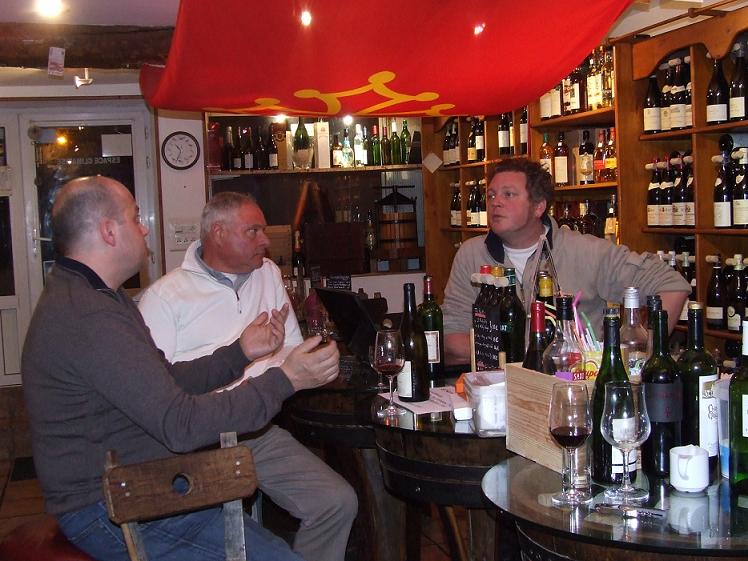
Chatting with Bruno Henri (right) in his treasure trove of a shop in Marseillan
After spending an hour or more chatting with Bruno, it was time to get some much needed sleep, before our 6am departure from the hotel. Thankfully, the journey back to the UK was much less traumatic than our outward journey, although our flight was delayed by around an hour, which I think was a knock-on effect of (yet another) French air traffic controllers’ strike. Actually, it was a great flight – very smooth, and with some wonderful views of the snow-covered Peak District as we approached Manchester Airport.

Flying over the Pennines on our approach to Manchester Airport -
- Kinder Reservoir is bottom left
- Kinder Reservoir is bottom left
So, another Vinisud has come and gone, but I have some great memories to look back on – and some great new wines to look forward to. If you are in any way connected to the wine trade and you ever get the chance to go to Vinisud (the next one will be in February 2012) then I can recommend it without reservation.
Wednesday, 24 March 2010
The Budget - yet another hike in the tax on wine
Well, I suppose it was bound to happen, although (if you believed some predictions badied about beforehand) it might have been worse. Nevertheless, today's rise in excise duty announced by our dear Chancellor, Mr Darling, means that the duty on a bottle of table wine is now perilously close to £2 (including the VAT element). I guess I have a vested interest, so I feel somewhat duty-bound (if you'll excuse the pun) to have a whinge about it, but these constant hikes in duty really do rile me. And I know for a fact that they rile most responsible wine drinkers.
I'm not sure that the small, though increasing, number of neo-prohibitionists in the corridors of power are that influential - yet. But their cause certainly gives the Government a fancy excuse for indiscriminately targeting all drinkers in their "fight" against the binge drinking culture. Whether or not they really are that bothered about getting to the root of that little problem is highly debatable (we all know it goes much deeper than the mere cost of alcohol). Somehow, though, I doubt it. Like petrol and cigarettes, the taxes on alcohol provide untold billions of Pounds in revenue and - not just in the current economic climate, but always - provides the Treasury with an easy win. I doubt that this latest increase will have the slightest effect on alcohol consumption in the UK. The streets of our towns and cities will still be thronging with binge drinkers, falling out of the pubs and clubs at the weekends (actually, make that most nights) but the Government won't mind, because it means even more money in the Treasury's coffers. And the fact that - for the majority of people who drink moderately and responsibly - it will make buying a bottle of wine to enjoy quietly at home with their evening meal ever more expensive means nothing to them because, when it comes to raising taxes, we are all fair game.
Anyway, rant over. Tomorrow, I'll get back to talking about some wines I have (very responsibly) enjoyed recently!
Saturday, 20 March 2010
Two lovely wines drank this weekend - Lebanon and Burgundy
I've been busy writing the website entries for all of the new wines coming in next week (including Mas Foulaquier and Domaine de La Marfée), so there's not been much opportunity to write up the final instalment from the Vinisud trip. I'll add that within the next day or two. Meanwhile, it is the weekend, so time to open a nice bottle or two - and these have gone down particularly well....
Hochar Pere et Fils 2002 - Chateau Musar, Bekaa Valley, Lebanon. I've heard great things about the 2003 vintage of this wine, but I saw the 2002 in a local shop today (which seems to stock the whole range, including Ch Musar 2002 red, 2003 white, 200(?) rosé and 200(?) Hochar white) so I took a chance. Actually, it is really rather good. Traces of the hallmark Musar volatile acidity - though somewhat less overt than in the "grand vin" - with old oak/cedar, poached raspberry and plum, wild strawberry, tea, forest floor and subtle hints of herb and allspice. The palate is velvety and warming, with a decent, long-ish finish. The tannins are quite soft, but there is a lovely backbone of acidity (the normal kind!) which combines beautifully with the almost sweet red and black fruit flavours. The result is tangy, almost sweet and sour. This is the first Hochar Pere et Fils I have tasted in donkey's years, and I have to say I'm smitten. OK, so it is perhaps not as quirky as Musar itself, but (even at a relatively pricey £11.50 - for this cuvée, that is) it gives a lot of bang for your buck. Lovely stuff!

Since we were in danger of completely draining the Hochar Pere et Fils 2002 before we even sat down to eat, I thought I'd better revisit the wine we started (but did not finish) last night. As it is a Burgundy (which, in my experience, don't tend to keep too well once opened) I thought it might have gone past its best after 24 hours, but not a bit of it. In fact, it has actually improved - though it was nice to begin with.....
Domaine Gachot-Monot "Aux Crots" 2004 Nuits Saint Georges. Surprisingly light in colour - even for a red Burgundy - being a very pale carmine-red, verging on amber, with a watery rim. Compared to the Hochar, the nose is actually quite tarry and even quite masculine, but with some backgound notes of violets and roses, it also has its feminine side. The fruit aromas tend towards bramble, but there are also notes of morello cherry, raspberry and strawberry, along with very definite hints of rotting leaves and undergowth. The palate is also quite tarry, even a touch rustic, but there is also a degree of elegance and charm that (were I tasting blind) would lead me only to Burgundy. Like the Hochar, it is tangy, with an underlying core of sweet fruit, but the acidity is even more heightened - lovely to drink on its own, but even better with food. I have 2 or 3 more bottles of this tucked away and, although it is lovely to drink now (unusually, for 2004 Burgundy) I suspect it will age nicely for a few more years yet.
Thursday, 18 March 2010
Vinisud report, part 7 - some highlights (plus a few lowlights) from our last day
Following another late night (dining with Jon and Rachel from Domaine Treloar at their rented apartment in Montpellier) Tuesday saw another relatively early start. Not too early, mind. Following a leisurely breakfast at our hotel in Marseillan, we were on the raod again by about 9.30, heading straight for another intensive day of tasting at Vinisud. By 10.15, the car parks were again filling-up fast, although we actually managed to find a parking space this time, saving us another long walk.
This being our last day at the event, I wanted to visit a few more of my own growers, as well as a few other growers whose wines I hadn't previously experienced, but that might have some interest. The beauty of Vinisud is that you don't have to go tearing about the countryside in order to try and visit a few growers. At Vinisud, it is a bit like the mountain coming to Muhammed - a significant majority of the growers, from small independent estates to the large cooperatives and negociant companies, have stands. Indeed, only three growers from my whole southern France list weren't actually there.
Anyway, here are a few thoughts and an occasional tasting note from some growers we visited on day 2 - in no particular order, and by no means a comprehensive list......
Domaine Treloar was, of course, one of my main points of call. Having been the designated driver on the previous evening, when we dined with Jon and Rachel, I didn't really get the chance to properly enjoy the wines they had laid on. We tasted through them all again on their Vinisud stand, although I didn't take any notes. Which may be remiss of me, since the whole range forms an integral part of my list, and I will be adding all of the new vintages very soon. Suffice to say that the wines were of a consistently high standard (I wouldn't have expected anything less!) and I look forward to listing them for many years to come. Jon and Rachel are a hard-working and very friendly couple, who deserve all the success that is surely coming their way - and I'm glad to be able to play my own small part in helping to promote their wines.

Rachel holds the fort, whilst Jon talks a visitor through his wines
Someone whose wines I was keen to taste again was Alain Chabanon. I used to sell a selection of his wines until a year or two back, having first met him at Vinisud in 2006. Those wines were pretty damn good, if a little expensive and a bit of a hard sell. We started with Trelans 2006, which is a blend of Chenin Blanc and Vermentino (a.k.a Rolle). It tasted quite oxidative, almost like a fino sherry. There were some interesting lemon and herb notes, but it was light and somewhat austere, to my palate at least. Rosé Tremier (2008, I think) was light-bodied and delicate, with some residual SO2 spritz. Le Petit Merle 2008 (predominantly Merlot) was light-bodied and quite fruity, but quite tannic and austere - even a touch green. Campredon 2008 is a blend of Syrah, Mourvedre, Grenache and Carignan. Lovely on the nose, but again oh-so-light, with little in the way of body or fruit. Les Boissieres 2005 (mostly Grenache) was richer, but tannic and tarry. I couldn't see where it was going to end up. Esprit de Font Caude 2005 (Mostly Syrah and Mourvedre, with a bit of Grenache) was more like it, with a lot more fruit. Still, it was so tannic, I'd say it needs 5 to 8 years to soften. Will the fruit last? Maybe, maybe not, but I won't be buying any to find out. Merle Aux Alouettes 2006 (which, as the name suggests, is predominantly Merlot) had a lot of fruit on the nose, but what there was on the palate was - yet again - totally masked by hefty tannins, which will take years to soften. Again, not for me.
I was left with the feeling that Alain Chabanon has totally changed his style of winemaking - and not for the better, in my opinion. His top wines have always been given long ageing in oak (in some cases, up to 36 months) but the results in years gone by were brilliant, complex and even "soft" wines that were approachable whilst young, even if they were built to age. Unfortunately, I can't see the current crop of wines doing the same thing. Shame.
I was left with the feeling that Alain Chabanon has totally changed his style of winemaking - and not for the better, in my opinion. His top wines have always been given long ageing in oak (in some cases, up to 36 months) but the results in years gone by were brilliant, complex and even "soft" wines that were approachable whilst young, even if they were built to age. Unfortunately, I can't see the current crop of wines doing the same thing. Shame.
Another important rendezvous for me was with Remy Reboul of Chateau d'Estoublon. Although I have been importing from Estoublon for a little while now, this was my first meeting with Remy. We didn't have time to talk at length, since the Estoublon stand (which they just happened to be sharing with their near neighbours Domaine de Trévallon) was extremely busy. Not surprising really, as the wines are top-notch and they had a fairly big stand, including an area laid out with some comfy chairs and tables - certainly no expense spared here! Whilst tasting through the wines, Remy asked if we would like a little food to accompany the wines. Why not, we said, thinking a few nibbles might tide us over until we went for lunch. Five minutes later, we were presented with what was pretty much a full three-course lunch of a standard which had to be tasted to be believed. I won't bore you with the details, although the coq au vin was utterly historic, with two pieces of succulent poulet laid on a bed of polenta with an amazingly rich and tasty sauce. Michelin star-standard cooking at a wine fair is not something one expects too often, but it certainly was appreciated!

Bernard compliments the chef on our delicious lunch
Although I have tasted most of the wines (and indeed sell them) it was nice to revisit the Chateau d'Estoublon Syrah 2008. A sample bottle I received a few months ago did not impress, and I gave it a rather unenthusiastic write-up in a blog entry at the time. But this one was spot on - rich but fresh, powerful but elegant, like a fine northern Rhone, but with an extra bit of southern Rhone stuffing. It may turn into something really special. It all served to confirm what I had previously suspected, which was that the sample bottle I had was faulty in some or other way. Chateau d'Estoublon is definitely an estate to watch.

Remy Reboul - winemaker at Chateau d'Estoublon
Once we had finished our lunch, Eloi Durrbach, who is something of a legend as far as I am concerned, came over to shake hands and exchange a few pleasantries. We tasted his Domaine de Trévallon red 2007, which showed all the hallmarks of yet another great wine. It was spicy and full, with oodles of garrigue herbs and poached red and black fruits, along with plenty of that juicy acidity which is a hallmark of Trévallon. At the time, I thought that it had some quite firm tannins, which would need a good few years of ageing to soften. It was only when I tasted more wines on other growers' stands that I realised that the delicious, but extremely rich and sweet dessert we had enjoyed on the Estoublon stand had made a big difference to my palate. A good few wines which I assume were actually very good actually tasted very tannic and austere after my taste buds had taken such a battering. Which leads me to suspect that the 2007 Trévallon is actually open for business and those tannins are very fine and pretty well integrated. Nevertheless, I think it will be a 15 year wine, if not 20 - and maybe even one of the great vintages.
That's it for now - in my next post, I'll mention a few more wines and growers of note from our last day, including a classic example of how to market some truly shit wines. No, I'm not cursing - they really were called "Vins de Merde"!
Subscribe to:
Posts (Atom)


