Friday, 25 June 2010

En vacances 4 - visits to Domaine de Cébene, J M Alquier, and the wonderful Languedoc scenery

All of a sudden, we've reached the last full day of our holiday. I am always sad to leave such a wonderful place, but a little bit of me always misses home. But this time - perhaps for the first time ever - I can see very few virtues in our impending return home! Obviously, we are looking forward to seeing Alex and Daniel again (though Dan is flying off to Corfu for 2 weeks on Monday morning) but I think TLD and I would have been glad to spend at least a few more days (or even weeks) in this beautiful place. Still, all good things must come to an end and I am consoling myself with the fact that the weather in the UK sounds as if it is almost as good as here. Somehow, though, a 3 bedroomed semi-detached house on a busy main road in urban Nottinghamshire seems a poor substitute for a beautiful house with a swimming pool in rural Languedoc. And I have to go to work on Monday. :-((

Never mind - onwards and upwards, as they say, and I also have a business to run, which I can't really do from here. And there's also a great summer of sport to look forward to, with the Open Golf Championship, the World Cup and, of course, Le Tour.

All in all, we have spent a bit of a lazy few days here in our hideaway in Laurens. Sunday and Monday, we pretty much stayed at the gite, lazing by the pool and cycling around the deserted backroads of the Faugeres countryside in the evenings, when the air was a little cooler. Tuesday was busier, as Jonathan Hesford came over to visit us. We drove to the nearby village of Caussiniojouls to meet up with Brigitte Chevalier of Domaine de Cébène and Guy Vanlancker of Domaine La Combe Blanche. Brigitte took us to see one of her vineyards, situated on an elevated and terraced mound no more than a couple of kilometres outside the village. This south-facing side of the vineyard is planted with Mourvèdre, whilst the north-facing side is planted with Syrah, the idea being that the later ripening Mourvèdre gets more of the sun, whilst the less demanding Syrah benefits from the slightly longer growing season of the north-facing situation. It is all relative, though, on a hill which sees a great deal of sun on all sides - especially on the day we visited! For a more detailed low-down on these wonderfully situated vineyards, and about Brigitte herself, see Tom Fiorina's excellent article on his blog, The Vine Route. Meanwhile, here are some photos.........

With Jonathan Hesford, Guy Vanlancker and Brigitte Chevalier - an awful lot of winemaking talent!

If you didn't know what schist "soil" was, then here it is -
- this metamorphic shale-based rock strata is a feature of the Faugeres terroir

Brigitte Chevalier's terraced vineyard, seen from the north

After looking at the vines, we repaired to Brigitte's cave, where we tasted the soon to be bottled 2009 Faugères cuvées of Les Bancels and Felgaria and also the 2009 Ex Arena, a Grenache/Mourvèdre blend from vines grown further south in the Languedoc, closer to the sea. All were really lovely, and worthy successors to their 2008 counterparts. Rather annoyingly, I seem to have misplaced my notes on these wines, for the time being. If/when they turn up, I'll publish them in due course. I hope the bottle of La Combe Blanche Pinot Noir that Guy kindly gave me also turns up somewhere, too!

After a lengthy tasting session, which also included some of Brigitte's other wines (made in collaboration with growers in Faugères, Minervois and Corbières) and the latest vintages from Domaine La Combe Blanche, we dined at a new restaurant in nearby Bédarieux. A three-course menu of salmon paté and salad, huge mussels stuffed with sausage meat accompanied by rice and a lovely curried sauce, and a simply wonderful chocolate cake and ice cream proved and interesting (and totally delicious) accompaniment to a load of red wines!

After we bade farewell to Brigitte and Guy, Jon, TLD and I made a quick visit to taste the wines of Jean Michel Alquier in the town of Faugères. A white Vin de Pays made from Roussanne and Grenache Blanc was delicious, as of course were his better-known red Faugères cuvées. I didn't make any notes, but I did buy a bottle of the white and a bottle of his young-vine red. I'll post notes when I eventually broach them.

Jonathan Hesford talks shop with Jean Michel Alquier

Wednesday was another lazy day by the pool, whilst on Thursday we drove south to spend a few hours on our favourite beach at Marseillan. When we returned in the evening, we put the bikes in the back of the car and drove 25 kilometres or so north-west to Mons. After almost 20 years of coming to Languedoc, I had never seen the Gorges de l'Heric, which carve their way for a good few kilometres through the Monts de l'Espinouse, a range of mountains in the Parc Régional de Haut Languedoc with jagged peaks reaching to around 1,200 metres (almost 4,000 feet) above sea level.

A view from the road, near the bottom of the Gorges de l'Heric

A small road, which is closed to public cars, runs up through the gorge, climbing at a fair old gradient for most of the way. The scenery is spectacular yet tranquil, especially in the hour or two before sunset, when most of the daytime tourists have gone.

Looking a bit knackered after climbing a few kilometres of the Gorges de l'Heric

Although the steep ride proved a little too much for TLD to handle, she did get part of the way up, before stopping for a rest. I went on a kilometre or two further, which probably took me a good few hundred metres up, as the road continued to climb at a very steep gradient - at a guess, I'd say it is somewhere around 11 or 12%. I was quite pleased with myself for having got as far as I did before turning around and going back down. There are steep drops down to the river at every turn, so the descent was quite scary, and my hands were certainly tired from all the braking, by the time I got back to where TLD was waiting. Nevertheless, I enjoyed it immensely and fully intend to return next year and tackle the whole ascent - unfortunately, on this occasion, it was starting to get a bit too dark, so it wasn't possible. If you are ever staying in the region, I thoroughly recommend a visit to the Gorges de l'Heric - whether it is on foot, or by bike, your senses will be truly heightened by this beautiful place.

As we set off back to Laurens, we were rewarded with the most spectacular sunset over the mountains - various shades of orange, pink, red and blue which were too difficult for a poor phographer like me to capture.

The Monts d'Espinouse, silhouetted against a stunning Languedoc sunset -
- believe me, it looked ten times as good to the naked eye

It was a fitting way to end what has been one of the most relaxing holidays we have had in years - and certainly one of the most memorable. We are sad to be leaving, but we will of course return.
    

Wednesday, 23 June 2010

En vacances 3 - some great wines plus a few lazy days

As I'm typing this, I'm sitting on the patio of our lovely gite in Laurens, in the Faugeres region of Languedoc. It is 11.30 (French time) and pitch dark. The heat of a scorching day has been replaced by a beautifully cool evening. There's not a breath of wind and the only sounds to disturb the still silence are the distant croakings of a few frogs (at least that's what I think they are) and the occasional hoot of an owl. It is complete bliss.

I've been a bit lazy with the blogging, actually, as it isn't as if we've been sitting sunbathing all the time - we have been busy doing other things too! Having arrived here in Laurens on Saturday to cloudy weather (and some rain on the way) we awoke on Sunday to a bright, sunny day. From what I am told, the Languedoc (much like many other regions of France) has had a funny old spring - in fact, not much of a spring at all. Until we arrived, the weather has apparently been cool and very changeable. Since Sunday, though, things have picked up considerably and summer has now definitely arrived with a vengeance in Languedoc. It took a day or two for the wind to die down, but the days are now accompanied by the gentlest of breezes and temperatures pushing 29C - too hot for me to sit out in (though TLD loves it) but the house is built of stone and is beautifully cool. Thankfully, the pool has also now warmed up a little, so provides some extra relief from the hot sun.

As I say, though, it hasn't all been about lazing around. Diane and I have been out for several bike rides in the surrounding countryside and yesterday (Tuesday) we visited Brigitte Chevalier at Domaine de Cébene, along with my good friends Jonathan Hesford of Domaine Treloar and Guy Vanlancker of Domaine La Combe Blanche. I'll tell you more about that visit in my next post. For now, I'll tell you about the brilliant Terre Inconnue.

Robert Creus (pronounced "Cruz" or "Cruise") works for the French Chamber of Commerce. He is actually an experienced scientist, having been heavily involved in the Ariane space rocket programme. He began making wine in 1997, having bought some old Carignan vines near the village of Saint Christol. He has since added Grenache, Syrah, Serine (a northern Rhone variant of Syrah) and a little Tempranillo. Some of the vines are very old, including some Carignan which is in excess of 100 years old. Having heard so much about the wines (especially having recently tasted a 1999 Carignan, which was pretty amazing) I was very keen to taste the whole range. The only really suitable day for us to visit was Saturday, on our way from the Cote d'Azur to Faugeres, since it entailed just a short detour from the autoroute between Nimes and Montpellier. Robert was working on the day we visited, so his father Lucien received us at his house in the small village of Saint Series.

Although Robert makes the wines, Lucien himself has more than a little involvement in Terre Inconnue. Indeed, he no longer has room in his garage for his car, since it clearly comprises part of the Terre Inconnue wine store! Lucien is a charming old man, with a real passion for the wine, not to mention a wicked sense of humour. He took us through the current range of wines - 6 different cuvées, made from around 4 hectares of vines from different parcels around Saint Series and Saint Christol. As Robert cannot be bothered with the bureaucracy and paperwork involved in Appellation Controlée or even Vin de Pays certification, all of the wines are labelled simply "Vin de Table de France". My notes were fairly brief, although I came away in possession of sample bottles of each, for which I will eventually post more detailed notes. Here are my brief impressions.

Les Bruyeres 2009
100% Carignan, with a nose of Bramble and damsons. Dense and mouthfilling, with fine young tannins and lovely structure. Immensely fruity, but with some nice herbal notes. My experience of the 1999 (which I blogged about a couple of months ago) tells me that this will age beautifully for a good few years, even though it is already lovely.

Los Abuelos 2002
100% Grenache. The nose is spectactular - a complex array of pastille fruits, leather, spices, herbs and forest floor. There's an impression of subtle coffee-infused oak, although only older barrels are used. There is still a lot of fruit, although it is beginning to take on all those wonderful secondary aromas and flavours. Dense, fairly rich, but supremely elegant, hugely complex and utterly gorgeous. A truly remarkable wine, from a difficult vintage.

Los Abuelos 2007
Again, 100% Grenache. The 2002 was an "extra", as I had asked to taste an older wine - 2007 is the current release. It is dense, full of bramble fruit and tar aromas and flavours, again with those lovely pastilley, crystallised fruits to the fore, and the same restrained use of older oak. Rich, concentrated and super-ripe, but so elegant. Very long, too. A superb wine.

Guilhem 2008
Grenache, Carignan and Tempranillo. This is so complex on the nose and I certainly need a longer look at this when I open my bottle, in order to fully appreciate it. Dense, fruity, spicy, with notes of polished wood. Rich and very long in the mouth. An impressive, complex wine, with enormous structure and not a little ageing potential.

Sans Nom 2005 (i.e. it doesn't have a name)
I'm not sure what the story is behind this wine, but it is by no means one of the more expensive wines in the Terre Inconnue portfolio. This is an extraordinary wine. Lucien gave me the rest of the opened bottle to enjoy with our meal that night, and you can see my full note in my post below. Huge fruit aromas and flavours, mingled with mint, eucalyptus and menthol, tar and polished wood. An amazing wine - very alluring and unusual, and utterly memorable.

Leonie 2003
100% Carignan. Fruit pastilles again, along with elderflower, mint, thyme and lavender. Less dense than you would expect from the vintage - elegant and almost feminine. Another lovely wine, and yet more evidence (as if I needed it) that Carignan can make extremely fine wines.

Sylvie 2005
Syrah and Serine. Not surprisingly, this smells a little like a northern Rhone, but with a Languedoc structure marked by notes of black olives, garrigue, bramble fruits and eau de vie. It is still clearly very young and immature, dense and slightly tannic, though the tannins are almost obliterated by the sweet fruit flavours. That said, it is hugely complex and I think there are hidden depths, which will only be revealed in time. And at 15% abv, it isn't weedy, either, although this is a classic example of a wine which is totally in harmony with its alcohol - it is warm and rich, without any feeling of heat. I think it will be brilliant in another 5 to 10 years.

After our tasting, Lucien's wife took pity on us (we hadn't eaten since breakfast) and prepared us a delicious dish of fried eggs, cured ham, pickled red capsicum peppers and crusty bread. A delicious combination, and just what the doctor ordered. Lucien then took us to see some of the vineyards, including some 40 year-old Grenache, a new Syrah vineyard and some amazing 100 year-old Carignan.

In a vineyard outside the village of Saint Series - I think this is young Syrah

There's no doubting what these vines are - precious 100 year-old Carignan

The vines were healthy and well-tended, with a reassuring amount of vegetation growing between the rows - Robert prefers as little intervention as possible, particularly in the vineyard. The wines are made as naturally as is sensible, with little or no spraying in the vineyard and only a small amount of SO2 used in the winemaking process. The result is a truly remarkable range of wines, with a real "wow" factor, and I hope to be able to add some (if not all) of them to my list, in due course.        
         
We are off to the beach at Marseillan tomorrow. I'll post some more stuff before the end of the week, including notes on our visit to Domeine de Cébene.
  

Saturday, 19 June 2010

En vacances 2 - moving day, plus an extraordinary Languedoc red wine

We have spent a fabulous week in Agay. Diane and I quickly become accustomed to not having the boys with us and it is actually shaping-up to be one the best holidays we have had in many a year. Of course, it helps enormously that we love each-other’s company, and the relative solitude of our surroundings and the fact that we can do what we want, when we want has been very liberating – and very relaxing.
Since the rains of Tuesday, the weather has been fine and settled. Yesterday (Friday) was the hottest day so far, with temperatures having reached 30C or more in the afternoon. A cooling breeze and the occasional dip in the pool provided welcome relief. The only exertion we subjected ourselves to was a cycle ride down into the town to buy bread for dinner.

Early evening on the beach at Agay

We then repaired to the living room to watch (or perhaps endure would be a better word) England’s latest World Cup Match against Algeria. Frankly, our national team is becoming a bit of an embarrassment. The Premier League may be one of the best in the world, but then again most of its best players are foreigners. The England team may have one of the best managers in the business, but even he can’t make a silk purse out of a sow’s ear. In fact, they are almost as bad as the current French team! The sooner the preliminary stages are over and the rubbish teams like ours are on the plane home, the better – then we can get down to watching some proper football.

Anyway, back to more important things. Thursday, we drove to Antibes, to visit Fabrice and Sandrine. As I mentioned in my earlier post, Fabrice is a Gendarme, and each promotion means moving to a new location. Having previously been posted to Melun (near Paris), Versailles and St-Girons (near the Pyrénées) he had to move to Antibes around a year ago. Fabrice was on duty until 6pm, so Sandrine took us for a stroll around the town and the port. Although Antibes is as chic as any other resort town on the Côte d’Azure, it seems much more at ease with itself and less pretentious than (say) Cannes. It is relatively small and compact and much more like a traditional old French town. Even in mid-June (i.e. not yet the high season) its streets were thronged with people and the shops and cafés were doing good business.

The port is a different matter – some of the ships and yachts have to be seen to be believed, and Antibes is clearly THE place to be seen, if you have a few million spare to spend on a boat. And although the harbour was full of mightily impressive boats, it seems the best ones are anchored out in the bay…..

This was probably the most expensive and extravagant one we saw (note the helicopter as an add-on)......

….. but this was my favourite – quite the most beautiful and elegant boat I have ever seen

Of course, if you have a few million left over after you’ve bought the boat, you might also be able to afford a house on Cap d’Antibes – probably the most exclusive location in the whole of France

We returned to Fabrice and Sandrine’s apartment to enjoy a lovely dinner, including some delicious foie gras de canard, accompanied by sweet Montbazillac and Champagne – truly a match made in heaven.

With Fabrice and Sandrine (and the impish Baptiste – the older and much less mischievous Florent took this photo)

At the end of a lovely evening, we bade our farewells and promised to meet up more often – 7 years since the last time is far too long. On the way back to Agay, we came off the autoroute at Cannes and took a drive along the Corniche de l’Esterel. Although it was dark, it was no less spectacular a sight, with the lights of the towns and villages along the coast making for a beautiful backdrop.

Today was moving day, as we headed to the hills of Faugeres in the Languedoc. We were sorry to leave Agay - it was a lovely area and the house was just perfect. And we will certainly miss that wonderful sea view! We will definitely return there soon – perhaps even next year.

As I type, we have now arrived at our gite for the second week, in the small town of Laurens in the Faugeres region. And – joy of joys – I have a wireless Internet connection, so will be posting often over the next week or so. I’ll tell you more about the place tomorrow, but suffice to say it is fabulous and exceeds our expectations.

On the way, we visited Lucien Creus, father of Robert Creus, the winemaker at Terre Inconnue, and were treated to a tasting of some absolutely wonderful wines. Again, I’ll tell you more in due course, but here’s a tasting note on one of the wines, which we finished off with this evening’s dinner……

Terre Inconnue "Sans Nom" 2005 Vin de Table
All of the wines of Terre Inconnue are labelled as Vin de Table. Robert and Lucien cannot be bothered with the bureaucracy involved in applying for appellation controllée (or even vin de pays) status for their wines. Therefore, all of the wines are labelled as Vin de Table – basically the “lowest” denomination possible for wine produced in France. Indeed, strictly speaking, it is not permitted to even show a vintage on the label, although Robert gets around that problem by including a code (in this instance, L:2005) in small print in the bottom right-hand corner of the label. Simples! It is pure Grenache from vines of around 50 years of age. The nose is one of the most beguiling and distinctive I have ever come across in any Languedoc wine, and which almost defies my descriptive abilities. There are dense, spicy, heady fruits galore, combined with menthol, mint, eucalyptus, lavender, thyme, red meat, tar and polished leather. The palate is rich, tarry, deeply fruity and again full of mint and menthol flavours – almost like cough mixture with lots of nice things thrown-in. It also has a savoury, almost meaty quality, yet manages always to be elegant, with a lovely balance of fruit, savoury, tannin and acidity. To the very last drop, it remained utterly lovely and enormously complex – it is an extraordinary wine, by anyone’s standards. I’ll try and describe some of the other Terre Inconnue wines tomorrow. Meanwhile, it’s been a long day, so I’m off to bed!

Thursday, 17 June 2010

En vacances!

Greetings from the sunny south of France! It has been a week or so since I last posted, but an Internet connection has been hard to find where we are, so here are several days’ worth of posts all in one – more in the nature of a dissertation than a blog post, I’m afraid!

If I had been able to find an Internet connection last Friday, I would most probably have written something more profound about how our role as parents to two young boys seems suddenly at an end. For the past 20 years, we have enjoyed so many lovely family holidays together, but this year is different. Our youngest son Daniel is now 18 and is flying off for a holiday in Corfu with his mates in a couple of weeks. He seems very independent and is always off doing his own thing. And after living a life of leisure for a good couple of years, 20 year-old Alex now has a full-time job, although he still hasn’t discovered the benefits of saving a little money (car, holiday, etc) or organising his life. So despite the offer of a free holiday with us, two weeks away from his girlfriend was always going to be at least a week too long. If he’d had the money (and the wherewithal to book a week’s leave) he could have flown down to spend a few days with us, but chose the easy route – as usual – of doing nothing.

So, having spent the previous few weeks and months looking forward immensely to our holiday, I spent the day before we left feeling pretty sad. To tell you the truth, it felt an awful lot like grief – the loss of something that we’ve always held so dear and will never get back. And I know that Diane felt the same as me (as evidenced by the tears as we left) but we also both realised that – for now, at least - it was us that needed the boys more than they needed us. One day, with a little luck, they will experience the same joys (and trials and tribulations) of raising a family as we have. Meanwhile, Diane and I will move on to a more independent life, safe in the knowledge that the boys can cope for themselves. I just hope the house is still standing when we get back!

Anyway, we had a ferry to catch at 7.30 on Friday morning, so we set off at around 2.30. It was an easy journey for most of the way, apart from some of the most torrential rain I have ever seen in the UK, travelling down the M2 in Kent. I have never seen a motorway get so flooded so quickly. It didn’t exactly bode well for the journey through northern France, but almost as soon as we left Calais, on the autoroute towards Reims, the sun started to peep through the clouds. Within an hour, we were driving in glorious sunshine.

The beautiful northern France landscape

Each time we stopped at the services, it was getting warmer and warmer. By the time we reached the southern Champagne region, the temperature was 28C, and it was just as warm by the time we reached our overnight stop in southern Burgundy. Our friend David Bennett had kindly given us the keys to his beautiful little hideaway in Saint Gengoux Le National – surely one of the prettiest villages in the whole of France. Before we arrived, we took a detour and a leisurely drive through the vineyards of Beaune, Meursault and Puligny-Montrachet, followed by a visit to the Cave Cooperative in Buxy.

A lengthy tasting left me unable to choose between so many lovely wines, so we ended up buying 18 bottles of mixed wines, including various cuvees of Crémant de Bourgogne, white Macon and Rully and red Mercurey and Givry. Lovely wines, every one of them. I have often said that the Neffies Cooperative in Languedoc is one of the best in France – well now I think that the Buxy Cooperative is the best in France.

After a lovely evening in Saint Gengoux, we set off for the final stage of the journey to our destination in Agay, on the Côte d’Azure. It was a rather longer journey than we had anticipated, but we arrived unscathed, despite a somewhat scary altercation with a mad Frenchman in a souped-up BMW, who didn’t take kindly to me showing him my brake lights in the outside lane of the autoroute when he was about 2 yards away from my bumper. Where do you go when you are trying to overtake and have two other cars in front of you? Anyway, despite the fact that this nutcase had previously wanted to reach his destination (possibly an early grave) as quickly as possible, he then decided to tailgate us for the next 20 or 30 kilometres – which was a bit worrying, because we were eventually going to reach the Péage, where we would have to stop. Luckily, he finally decided he’d had enough of trundling along the inside lane at speeds of 50-60 mph and sped off into the distance. Thankfully, we didn’t encounter him again and I learned a valuable lesson – don’t offer internationally-recognised hand signals to people with cars that go faster than mine!

Our house (or villa) has a lovely situation on the Corniche de l’Esterel, which hugs the coastline all the way between St. Raphaël and Cannes and onwards towards Nice, Monaco and the Italian border. Set into the hillside with the coastal rail line directly behind, all we have between us and the sea is the Corniche and the villas on the far side, the gardens of which are literally lapped by the waves. It really is a stunning location. The view from the pool, which is high up behind the house, affords magnificent views out into the Mediterranean, and the view from the living room is almost as good.


The view from our pool........

........and from the patio

It is nice to wake up to such a wonderful view. And all we have to disturb the peace and tranquillity is the distant crashing of the waves and the occasional passing train or car. The house itself is very comfortable and, whilst a little rustic, it has all the facilities we need – private pool, garage, washing machine, barbeque, DVD and TV. We don’t usually feel the need for a TV whilst on holiday, as we like to spend our time outside, although it has certainly proved useful this time, if only to watch the odd World Cup match. We didn’t see much of the England v USA match, but I don’t think we missed too much excitement either. Some of the subsequent matches have been very entertaining, though, and it seems to be shaping-up into an interesting tournament. I’d actually fancied Spain to win it, but the Swiss gave them a good game last night and certainly deserved to win.

I have quite a few relatives in France (my Dad’s family moved there from Poland in the mid-1930’s) and my cousin Fabrice lives in Antibes, his current posting as a Gendarme. So on Sunday, he and his lovely wife Sandrine and their two boys Florent and Baptiste came over for a barbeque and a trip to the beach. It was lovely to see them again, as we had not seen each-other since my cousin Dominique’s wedding in 2002. Today, we will visit them for dinner at their apartment in the centre of Antibes.

My cousin Fabrice and his lovely wife Sandrine

In the evening, after they had left, Diane and I went for a ride on our bikes for a few kilometres along the Corniche. Although the road is by no means flat, the inclines are gentle and fairly short – ideal terrain for Diane to get used to riding a bike again! Her friends had all been saying how jealous (not) they were that she was going to be doing so much cycling on holiday. Well, I am happy to report to Diane’s cynical friends that she enjoyed it immensely and is looking forward to doing a lot more cycling - especially when we get to the hills of Faugeres!

Monday was a lazy day for us, spent mostly by the pool, although we did venture out on the bikes again in the evening.

Tuesday began cloudy and overcast, which eventually turned to intermittent showers, so we decided to drive along the coast. We were going to take the train, as – like the Corniche – it pretty much hugs the coastline all the way to Italy. But we decided to take the car instead, since it meant we wouldn’t be constantly getting on and off trains and we could work to our own timetable. First stop was Cannes. Just as we got out of the car, it started raining, but only for a short while, so we took a stroll along the main drag, to see how the other half lives (and shops). The prices in some of the shops were eye-popping – I saw more than a few skimpy dresses or small items of jewellery selling for several thousand Euros. Some of the shops were less vulgar and didn’t even bother to display prices. I guess if you need to ask the price, you certainly can’t afford it! There are a few free bits of beach in Cannes, but most of it is cordoned-off and clearly reserved for the use of the guests in the numerous plush hotels. To be honest, it really isn’t my kind of place (or Diane’s, thankfully) and the only really interesting bit is the exhibition centre used for the Cannes Film Festival – we spent a few minutes looking at the handprints of all the famous film stars inlaid into the tiles nearby.

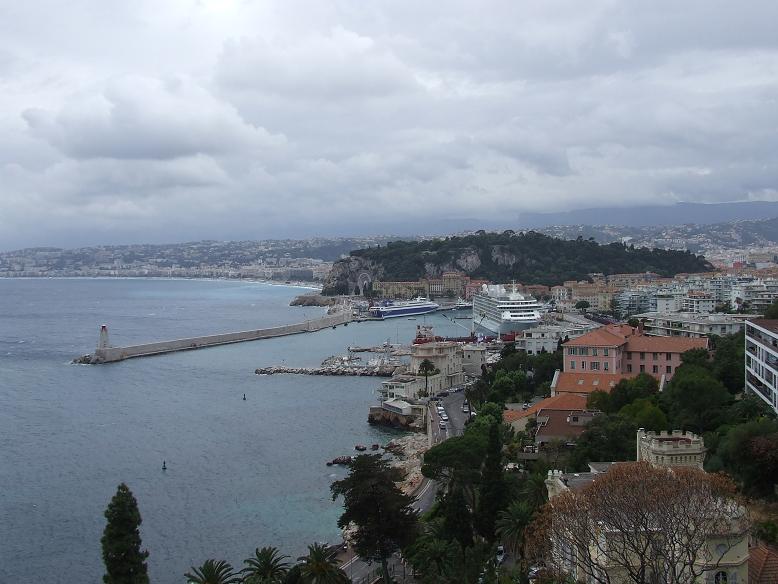
Then we drove on along the Corniche, making a few stops here and there to take photos of the spectacular sea views. East of Cannes, we took the more direct road towards Nice, which isn’t at all pretty and passes through some grubby, run-down places – a mixture of wasteland, building sites, ugly towns and high-rise developments. When we got to Nice, we drove straight down through the town to the promenade which, I have to say, is utterly gorgeous – a 2 or 3 kilometre stretch of beach (although it looks like shingle, rather than sand) runs from one side of the bay to the other. I have never seen such a blue sea – in fact so blue, it was almost turquoise. Unfortunately, parking along the promenade is not easy, so we just took a slow drive along to the other side, enjoying the view and the temporary bright sunshine. Just around the corner from the main bay is the harbour, which we reached just as a ferry was departing for Corsica.

Nice harbour, with the main resort top left

The road climbs quickly from there and the view from the highest point is a stunner. In fact, there are countless stunning viewpoints along the whole stretch of road from here, taking in Villefranche-Sur-Mer and Beaulieu-Sur-Mer.

Villefranche-Sur-Mer

Then, all of a sudden, we were in Monaco. If you’ve watched the Monaco Grand Prix on the TV, or have visited Monaco yourself, then you hardly need me to tell you how small and built-up this place is. Wedged between mountain and sea, there is little room left for building outwards, so most of the new buildings now go upwards (and in some cases downwards). Although I’m not a fan of high-rise developments, I guess they have little option here and, being set against the backdrop of spectacular cliffs and mountains, they actually seem to add to the charm of the principality. Not that this is a place without some fantastic old(ish) buildings – the Opera, Casino and Hotel de Paris are magnificent buildings, and there is a lot of great architecture in the older parts of town. And of course, the place simply screams wealth and decadence.

Monaco, seen from the east, near Menton

The Casino

Hotel de Paris

We drove around the town a couple of times before we were able to find a suitable parking space, which almost inevitably meant driving along several parts of the Grand Prix circuit. Save for a couple of areas of red and white-striped verges (and no Armco barriers), you wouldn’t know it, of course, for the whole of the race track comprises what are – for 51 weeks of the year – very busy public roads. It was raining heavily by this time, but we enjoyed seeing the sights and strolling around what is actually a very pretty town – even in the rain.

F1 fans should recognise this stretch of road

The sun made a very welcome return yesterday (Wednesday). There was still a hefty onshore breeze (as evidence by the white horses on the sea) but we had a cloudless sky and temperatures in the high 20’s Celsius, so we enjoyed another relaxing day by the pool.

Finally, here are some rather sparse notes (mainly from memory) on a few wines we have enjoyed over the last few days.

Vignerons de Buxy Buissonnier Demi Sec Crémant de Bourgogne was a delicious way to end a long day’s driving to Saint-Gengoux. A blend of Pinot Noir and Chardonnay, it was refreshing, off-dry with a hint of richness and minerality and a lovely mousse - and crammed full of lovely stone fruit flavours.

Vignerons de Buxy Clos de Chevris 2007 Givry, enjoyed with our Sunday barbeque, was a beautifully light, yet not unsubstantial expression of pure, youthful Pinot Noir – fruits of the forest, with leafy, forest floor notes, and a palate of sweet but tangy strawberry and raspberry and a hint of cream.

Thierry Allemand “Chaillot” 1998 Cornas was one of several bottles I brought with me to enjoy this week, before we reach the vinous heaven of Languedoc. I don’t often use the word “strong” in a tasting note, but this one was exactly that – strong, without being overly tannic or alcoholic (12.5%) and robust, without being overly rustic. It was absolutely loaded with rich, dark blackberry and cherry fruit and not a little spice. It was identifiably Cornas, though it has yet to develop the classic smoky bacon and violet notes on the nose. That said, it was still lovely to drink, even at this relatively young age. It is a very fine wine indeed and definitely has another 5 to 10 years’ of ageing potential before it reaches its peak. I’m glad I have another bottle.

Tuesday night, we “slummed” it with a bottle of supermarket Côtes de Provence – simply by way of experimentation, you understand. It cost us all of 1.95 Euros and I have no idea what the grape mix was (and it was non-vintage) but it was remarkably OK – even good. It ticked all the right boxes – spicy red and black fruits, decent acidity and rustic (but not harsh) tannins made for a very pleasant drink to accompany some steak, Toulouse sausages and pasta with a rich tomato sauce. I’d happily drink it again – though not too often. Life is too short to drink cheap wine! Last night, we stepped up a notch, with a remarkably good Domaine Bech 2008 Costieres de Nimes – also a supermarket wine, though a little more “expensive” at 3.95 Euros(!) It was absolutely delicious and true to its appellation – plenty of dark, ripe fruit, tar, herbs and spices and a certain yeastiness which made it all the more interesting and yummy. In fact, it was so good that I may go back to buy a few more bottles to take home.

As a postscript to this entry (which I have been piecing-together over the last couple of days) we saw the news on the TV last night about the terrible floods and resulting deaths in and around Draguignan. This happened on the very same day (Tuesday) that we made our trip to Monaco. It was a rainy day, for sure, and we had torrential rain on the way back to Agay on the autoroute, but we didn’t realise things were that bad inland. Yesterday (Wednesday) saw a return to glorious weather. There was more rain last night, but the weather forecast is now really good for the rest of this week and the whole of next week - fingers crossed!
       

Wednesday, 9 June 2010

A few nice wines from the last week or so

I've been slack, this week, having not posted for 5 days. I've not been lazy - honest, Guv - I've just been too busy with lots of other stuff. So here's a round-up of some interesting wines tasted and/or consumed over the last week or so, beginning with an interesting quartet from just another week at Nottingham Wine Circle.

Meursault-Genevrieres Cuvée Philippe-Le-Bon 1984 Hospices de Beaune
Yellow/gold and perhaps turning just a bit oxidised, but still hanging on nicely. Rich, lemony, mineral and just so Burgundy! Nice grip and nice length - a lovely old wine.


Bonnezeaux 1980 Rene Renou
This was a stunner - petrol, lime oil, wet wool and slate on the nose. On the palate, it had such amazing acidity, with the sweetness just beginning to fade, revealing a herby, slatey, zingy wine with gorgeous lemon and lime flavours. Lots of secondary/none wine-specific things going on too. 30 years old and just perfect.


Bourgogne Rouge 1990 Madame Leroy
Earthy, smoky, still very fruity, with forest fruits and undergrowth - a glorious perfume. Complex and still fruity on the palate. Elegant and very feminine. A glorious example of a "basic" Burgundy from a top, top grower, which is just fantastic to drink now, but with years of life left in it.


Corton-Pougets Grand Cru 1991 Louis Jadot
If it hadn't followed the above wine, this one might have stood out more - but it paled in comparison somewhat. Smoky, secondary, earthy. Bigger and less refined than the Leroy, though still a very enjoyable old Burg.

Carrying on the Pinot theme at home the following evening, I opened this little beauty. The colour is ultra-pale for a red wine - almost a deep-ish rosé, in fact, with hints of ruby and tawny. The nose is spectacular - wild strawberries and raspberries, with notes of brioche and rotting leaves, cinnamon and herby nuances. There is a hint of woodiness, but at the cedar end of the spectrum, rather than full-on oak, suggesting careful use of older barrels.The palate is a mélange of strawberry, raspberry and peach, with even a hint of lychee, all coated in a big dollop of fresh cream - a wonderful combination. What tannin remains is like velvet, and there is plenty of mouth-watering acidity (bordering on VA, which is just fine by me). A wonderful wine, from a wonderful grower. Incidentally, it actually goes brilliantly with milk chocolate!
Available on my website at £21.50.


Domaine de Montesquiou Jurançon Sec 2005
Some fabulous weather last weekend made me crave for something zingy and refreshing, but just a little bit serious - and Jurançon Sec fit the bill. This has turned a lovely golden colour, shiny and limpid. The nose is quite beguiling, offering a combination of lime zest, marmalade, honeysuckle, oregano and wet stone – you really can smell the minerality. The palate has a certain richness of flavour, with subtle hints of toffee and honey, yet is so zingy, lemony and laser sharp that it remains brilliantly focused and tightly-knit. It really is intense, mouth-watering stuff, and actually seems to have a good few years of development left. It also happens to be an excellent advert for DIAM corks – the one in this bottle remains in perfect condition and has obviously done a great job in preserving the wine. All-in-all, this wine provided a lovely surprise and a wonderful pick-me-up on a balmy early summer’s evening. What a shame it was my last bottle!


Heathfield Ridge Patrick Cabernet Sauvignon 1998 Coonawarra
After presenting a tasting of my wines to a local group, I popped into the Lincolnshire Poacher, to see a couple of people at the Wine Circle and stayed to sample a few of the wines in the weekly "bottle blind" tasting. There were some nice wines, but one that appealed to me in particular was this lovely Coonawarra Cab. Which is surprising, because I don't have much time for Australian wines, these days. But this one isn't a big blockbuster. It screams Coonawarra, simply because it possesses a relatively light touch, in that it has some elegance and bags of acidity (along with the ever-present mint and eucalyptus leaf aromas and flavours) and even a refreshing touch of "greenness". There's plenty of tangy, almost red cherry fruit, with a bit of blackcurrant, and lots of leafy, earthy flavours. There is some oak influence, but it is relatively subtle and restrained. Some of the others didn't care for it, but for me it made a refreshing change from the (usually) 90-odd percent European wines we tend to taste at the Wine Circle and it had a good degree of elegance and charm. Sometimes one simply has to appreciate that Australian wines are, well..... Australian. Put simply, no other county makes wines like them, and there are obviously still a few Aussie wines out there to please even the most conservative of palates - and this one certainly pleased me. I must try more Australian wines.

Diane and I are off to France tomorrow, for a well-earned holiday, leaving the house in the "capable" hands of my boys. I just hope we have a house to come back to after they've finished with it!

Keep watching, as (Internet access permitting) I'll be posting plenty of stuff to do with both wine and the places/people we'll be visiting.


Friday, 4 June 2010

A nicely aged southern Rhône wine

Domaine Rabasse-Charavin 2000 Côtes du Rhône Villages Rasteau
This is a classic example of a wine that has developed some interesting - how shall I put it - "secondary" aromas and flavours. The wines of this estate have always come across as slightly earthy, even in their youth, but this one has become a bit of a brett monster! That said, the brettiness (basically, a funky - some may say shitty - sort of aroma, caused by the bacteria called brettanomyces, which eats away at the fruit) does blow off a little after a while in the decanter, but the aromas are still very meaty and earthy, like beef gravy or Bovril. Behind the savouriness, there still lies some rich, brambly, leathery, Grenache-dominated fruit pastille aromas and a nice lift of slightly volatile acidity. And the palate is still loaded with deep, dark fruit flavours. The tannins are still quite chunky and rustic, though balanced by really good acidity, and these combine with the fruit and savoury elements to delicious sweet and sour effect. It's quite a big wine, with a typical southern Rhone warmth, almost (dare I say it) like a rustic, aged Chateauneuf-du-Pape. As a regular visitor to this estate (and other Rasteau and Cairanne growers) I used to drink a lot of wines like this - indeed, I used to sell this one. I still enjoy them very much, although they can sometimes lack the elegance I find in many of their Languedoc counterparts. But this wine, on this particular evening, is going down very nicely. Perhaps today is a fruit day - or maybe even a brett day!
    

Sunday, 30 May 2010

Biodynamics - a few rambling thoughts

Following on from a big newsletter sent out to my customers and subscribers on Friday, which included news about my new wines from Mas Foulaquier and Domaine de La Marfée, one of my customers emailed me to ask if I could reference any serious evidence for the beneficial practices of biodynamism, especially at harvest time. It took me a while to compose a reply, not least because it was such a tough question to answer, but it did make me think rather deeply about whether there is any real evidence to support what this customer quite rightly referred to as a philosophy. My reply ended up being rather rambling, but I thought it might be interesting to post my thoughts about it here on my blog, if only to see if anyone out there has anything to add.

I'm not a religious man, so I guess I have to "believe" in something(!) Nobody has ever produced a single shred of evidence to prove that "God" exists, but billions of people still choose to believe. Given that I am in the minority, does that make me wrong? Conjecture aside, I do believe that at least some biodynamic principles are plausible, though (since I'm not a scientist or an expert on the philosophy) I couldn't really say which bits. All I can do is offer random thoughts;

The world is a living, breathing thing, and every single living thing on it owes its existence to a big ball of gas 93 million miles away. The tides are governed by a big piece of rock a quarter of a million miles away. The rest of the solar system and the stars beyond may or may not have an influence on our lives (that said, I'm not big on astrology, either). So I guess the universe does, to a greater or lesser extent, have an influence on what happens. What I do know is that we all feel different from one day to the next, for some inexplicable reason. And on some days, it seems like everbody we encounter is having a bad day (or a good one). For instance, on one day, a car journey might be completely uneventful, whilst the next day it seems like everybody who gets behind the wheel is a demon and you just thank your lucky stars(!) that you reach your destination unscathed. So if our own daily lives and our moods are affected by some or other mysterious force, then why not the plants too?

In terms of wine, have you ever noticed how two bottles of the exact same wine, consumed at different times, seem to smell and taste different. One may give us great joy, whilst the other may be merely good. Always assuming that neither of the bottles are corked, oxidised or in any way faulty, how do we explain that? I hear that Tesco always schedule their trade tastings on "fruit" days. If the greatest force in retailing (we won't go into whether that force is good or bad here) plan their tastings based on the biodynamic calendar, then who am I to argue? ;-)

As for the vineyard preparations, I'm not sure I can believe that the burying of cow horns filled with cosmic potions has any great effect, but the biodynamic potions sprayed on the vines is another matter. Until recently, the so-called health experts poured scorn on homeopathy, and yet homeopathic medicine is now freely and openly used in the NHS. So if it works on us, why not on plants and vines?

As for what happens at harvest time, I think every winemaker worth his (or her) salt will harvest at the "optimum" time (i.e. sugar, ph, or whatever other method they go for). Whether or not that happens to be on the appropriate day of the bio calendar, I don't know. I do know that many winemakers choose to rack and/or bottle their wines at certain times of the lunar calendar, so there's nature dictating again.

But as I've said on numerous occasions here on my blog, whatever one thinks about biodynamicism (extreme organics or just plain whacky) it is a philosophy which does tend to go hand-in-hand with a healthy respect for the land and a fastidious approach to winemaking. Even if it is merely extreme organics, then it must be even better (and better for the land, the flora, the fauna and us) than mere organics.

I did say my reply was a bit rambling, and I guess it proves nothing. In fact, there is little evidence (beyond the mere anecdotal) to prove that biodynamism has any scientific basis. But the proof of the pudding, as they say, is in the eating. Granted, not all biodynamic growers make great wine (especially some who also indulge in extreme "natural" winemaking) but a far bigger percentage of them do make great wine than those at the other end of the spectrum who take the "easier" route.

As always, I'd be interested to read what others think.
 

Monday, 24 May 2010

I'm In A Roussillon State Of Mind(!)

I must apologise for this, but I cannot resist posting a note on yet another Roussillon wine, this time a red from Collioure. Faced with so many new wines to taste, I have probably done what anyone would do (be it wine merchant or drinker) in that I have tended to opt first for the ones I think will excite me most. Well, this is the second to last (with only the new vintage of Domaine Treloar Le Secret to go - don't ask me why) and it is a real cracker, worthy of a post of its own.

Made by the diminutive and bubbly Laeticia Pietri-Clara, this is her "basic" Collioure. A few years ago, someone asked her what this cuvée of red Collioure was called (at the time, it didn't have a name). So she christened it "Sine Nomine", which is actually Latin for "without a name" - or words to that effect. Laeticia's strongest suits are normally her sweet Banyuls wines (I currently list her wonderful Cuvée Mediterranée 2003) and her dry white Collioure (currently the 2008 vintage). The reds have always been good, if not not remarkable. In fact, she makes at least 2 (and sometimes 3) different dry red cuvées, and the only one that has ever really appealed to me is this one. And I have to say, she has excelled herself with the lovely 2007.


This offers lifted aromas of strawberry and plum, combined with notes of spring flowers, violets and undergrowth. There is also a subtle, yet very definite hint of the sea (Collioure is situated right on the coast, where the Pyrenées tumble into the Mediterranean). And all of these aromas combine beautifully in a wine of considerable elegance. The palate is elegant, too - in fact, very feminine - with the rich red fruit flavours balanced by juicy acidity and tannins as soft as velvet. That maritime influence again has its say - not so much salty as savoury and herby, along with a hint of liquorice and a long, softly spicy finish. This really is a lovely surprise and is very definitely the most elegant of my Roussillon wines - I'm rather thrilled with it, but also a little miffed, because I only bought a handful of cases! A bargain at £12.95.

Food-wise, it would go beautifully with garlic-infused lamb, or a lamb tagine, a roast rib of beef. Dare I say, it would probably be a great match with a full-flavoured fish dish with a fishy/creamy sauce. It also happens to be devilishly drinkable on its own, whilst typing yet another glowing tasting note on yet another fabulous Roussillon wine!
        

Sunday, 23 May 2010

An amazing 17 year-old Cornish wine

I've tasted a good many English wines over the last few years and, to be honest, the only one that really excited me was a vintage Nyetimber (1999, I think) with a few years of bottle age. Until this week, that is, when one of the Nottingham Wine Circle members produced this amazing little beauty....

Veryan Huxelrebe and Madeleine Angevine Medium Dry 1993 Cornish Table Wine
Yes, you read it correctly, a 1993 English wine. Or Cornish, to be exact - and just in case you miss it on the main label, there's a small sticker which proudly states "Made in Cornwall". For the uninitiated (and that includes me!) the back labels states as follows;

"Huxelrebe was bred in 1927 at the Alzey Research Institute from Gutedal & Courtillier Musque. Madeleine Angevine7672 was introduced into the UK by Barrington Brock in 1957 and probably originated in Siebeldingen."

Well that clears that up, then!

Anyway, what of the wine itself? This being a blind tasting, some people were guessing Germany (possibly Riesling or Muller Thurgau), whereas others were in Alsace (Pinot Gris or Blanc). When those were ruled out, we were all over the place (Luxembourg, Austria, Hungary, etc). It was only by a slow process of elimination that somebody finally suggested England. "Sort of", came the reply. "Cornwall, actually". We guessed wildly at the vintage, but nobody got close to 1993. I have to say that I have tasted many a wine with a far more aristocratic reputation that gave far less enjoyment than this 17 year-old Cornish beauty. The nose was quite complex, with aromas of Cox's Orange Pippin, lime marmalade, kerosene and brioche.The palate was citrus and stone fruit, with a good deal of stoney minerality, almost Riesling-like. Steely dry, but with a depth and richness brought on by years of bottle age - lime marmalade again. It was surprisingly long and complex, and very much alive. Everybody seemed to like it, but I really loved it, so much so that I took the bottle home at the end and enjoyed the last half glass the next day (and it was still lovely). Frankly, this is a wine that I would gladly drink a lot more of - so if anybody reading this happens to have a few bottles lurking in their cellar, please let me know. ;-)  In fact, it was one of the most pleasant wine surprises I can remember, and ranks right up there with the unbelievably good Lohengrin Liebfraumilch 1987 (in a 1 litre bottle) I took to a tasting 4 years ago!

It seems that Wine Circle Secretary David Selby can do no wrong with the amazing selection of wines he brings every week. Usually, they are a lot more "special", but this little gem gave me (and others) much pleasure.

If you are even geekier than me about wine and want to know more about Huxelrebe and Madeleine Angevine, here's a couple of links;


Happy reading!
   

Saturday, 22 May 2010

A real taste of spring (or do I mean summer?), plus one more fabulous Rousillon wine

Well, spring seems to have arrived with a vengeance in the UK. The past few days have been warm and generally sunny, but Saturday saw the arrival of positively Mediterranean weather, with temperatures in the mid-to-high 20's celsius. Mr Blue Sky finally showed his face, with literally not a cloud in sight from dawn until dusk. And although my golf was nothing to write home about, I did come home with face and arms several shades redder than when I left. This fine weather may not last (I hear that temperatures will drop again in a few days) but it has certainly made a change to be bathed in warm sunshine, after the somewhat cool weather we have endured in early spring.

Anyway, apologies for writing about yet another Roussillon wine, but the one I opened this evening (there are now just a couple more to go before all of my new wines are written-up) was a cracker.....

Domaine Sol-Payre Imo Pectore 2006 Cotes du Roussillon

Mourvedre, Syrah and old vine Carignan, aged in barrel for 12 months. The nose is spectacularly complex, with aromas of cherry and bramble fruits steeped in eau de vie, allied to notes of cocoa, sandalwood, leather, tobacco and aromatic spices - a lot of descriptors, I know, but trust me, they are all in there. This wine is clearly the product of some beautifully ripe fruit and masterly barrel ageing. The palate is equally classy and complex, with generous, sweet black fruit flavours complemented by tangy sour cherry and orange peel, whilst subtle notes of garrigue herbs and red meat add savouriness. Ripe, velvety tannins and ample acidity complete the package. Restrained power and elegance are the watchwords. In fact, having already written that the 2007 Cuvée Ater (see my entry of Tuesday 11 May) is the best wine of the current crop from Sol-Payré, I must say that this one compares very favourably. The wines of Domaine Sol-Payré have always been reliably lovely, but it is clear that winemaker Jean-Claude Sol is not happy to rest on his laurels. As with the Ater, this one has raised the quality to a new level. Yet another fantastic wine, and a complete and utter bargain at £13.50.

Tomorrow, I shall post a on a rather lovely 17 year-old English wine(!)
   

Tuesday, 18 May 2010

Yet more delicious Roussillon wines

Continuing my arduous and brave quest to taste my way through a whole host of new Roussillon wines, here are my thoughts on a couple more, tasted over the last couple of evenings. Neither are profound, but both are testament to what Roussillon is capable of at the "lower" end, when it is doing its own thing and not trying to emulate wines from other regions. This pair are just about as "Roussillon" as you will ever get.

Made from 100% old-vine Muscat A Petit Grains, lightly fortified with grape spirit. If you have ever been lucky enough to enjoy eating fresh muscat grapes (they are often available in French markets and supermarkets in late August) then you won't need me to tell you how delicious they are. And wines don't come much more "grapey" than a fine Muscat de Rivesaltes - and they don't come any better than this little cracker. The nose offers a riot of (you guessed it) grapey aromas, with notes of lime marmalade and clementines. The palate is both mouth-filling and super-fresh, like munching on a handful of grapes, but with an ethereal, marmalade-y richness. The inherent natural acidity and slight pithiness of the Muscat grape are complemented perfectly by just the right amount of fortifying grape spirit. To be honest, I have rarely tasted a bad Muscat de Rivesaltes (with such wonderful raw material, that would be difficult) but some cheaper examples can be a bit too hot for their own good. Not this one, though. - it manages to be both rich and mouth-watering at the same time, whilst the grape spirit adds a refreshing tanginess, rather than heat. Young Muscat de Rivesaltes is never profound, although I've heard tell that if you are brave enough to age it for 10 or 15 years, it can be. But why wait, when it tastes this good at less than 2 years old? It is utterly lovely - and very long, too. In all my years, I've yet to taste a better one. Yummy! A perfect match for patés, foie gras, cheeses of all descriptions, with fresh fruit, or as a delicious aperitif. A bargain at £11.50.


50% Syrah, 20% Grenache, 30% Carignan, aged in vat. Medium ruby red colour with a light-ish rim. The nose offers enticing aromas of cherries, stewed plums and raspberries. Notes of herby garrigue and red capsicum, combined with a touch of meatiness, add savoury nuances. The palate is loaded with fresh, juicy red cherry and raspberry fruit flavours, again with some savoury/meaty notes. All of that flavour, combined with a healthy dash of tangy acidity and just the right level of tannin makes for a wine that is deliciously drinkable already. There may even be the merest hint of spritz, which serves only to lift it further above the ordinary. This wine shows just how good Roussillon reds can be at the "lower" end, with an aromatic and flavour profile not a million miles away from really good Cotes du Rhone - but with extra dimensions of freshness and lift. The much-maligned Carignan does more than its fair share to add to the interest and drinkability of this wine. And it actually tastes lovely, even after sampling the delights of the Muscat de Rivesaltes - no mean feat, for a dry red to follow a sweet white! This is yet another winner from one of the most reliable growers on my list. A versatile red wine, to enjoy with roast beef or lamb, roast vegetable dishes, cheese, pasta. £8.95.
 
Right, dinner calls...........
   

Monday, 17 May 2010

I hear summer is on the way..... so why is spring still dragging its feet?

Apart from a warm spell in mid-April, UK temperatures this spring have been disappointing, to say the least. And the weather in Spain wasn't particularly kind to us, when we spent a few days there the other week. I've also heard tell that southern France (not just Languedoc and Roussillon, but Provence too) has seen some weird and unseasonal weather this year - much of it cold. So what of climate change (or global warming, as it used to be termed)?

There was an an interesting special edition of Springwatch on the TV this evening, highlighting the potential impact of climate change on the delicate balance of our native flora and fauna. It was a good watch and, to its credit, didn't attempt to paint a picture of total doom and gloom - some species will find their habitats under threat, whilst other species will thrive under the changing conditions. Whatever the truth behind climate change (is it all down to man, or is it as much down to the natural cycle?) we do seem to be experiencing more extremes of weather than we used to. That said, it could be argued that this year has so far been a bit more "normal", in that we had a fairly long, cold winter and have since "enjoyed" a somewhat changeable spring. So much so that my grapevine seems to be way behind in its development, compared with the same stage in the last few years. The buds normally begin to appear in late March and have usually burst by early-to-mid April. Not that I'm in the habit of recording these things too closely, but by now I would have expected the new shoots to be growing vigorously (to the tune of a few inches per week), whereas they are still progressing at a snail's pace. Here's a picture taken yesterday, of a section of the vine I have trained between the kitchen wall and the garage, which gets maximum exposure to whatever sun we might get.....


Not that I'm too worried, since the fruit (usually lots of it) is of little use for anything other than jelly/jam and the vine is really only ornamental. Frankly it is a bit of a pain to look after, since it needs at least 2 or 3 prunings per summer, in order to keep it under control and avoid it pulling the house down! At least other things are starting to grow well, though, as we arrive at what is traditionally my favourite time of year. The Wisteria is just beginning to flower and will soon be in full bloom, whilst the Clematis at the top of the garden seems to climb higher and higher each year up the large tree planted in the school caretaker's garden on the other side of the wall. For just a few brief months each spring, it really is a glorious sight - and a glorious scent, too. Here's another photo of the sight that greets me as I turn onto the drive.....


Anyway, climate change or not, I'm going to be optimistic about this year. Despite the reluctance of the Met Office to make any sort of prediction about the weather for the forthcoming summer (they've got it so badly wrong in recent years, it is hardly surprising) I have a feeling in my water that this summer is finally going to be that barbeque summer that we've all been waiting for. Remember 1976? Cold winter, awful spring, snow in early June? Look what happened after that..........

Just remember, you read it here first. ;-)